Mines by JILI: Hidden Coins, Bombs, Multipliers & Jackpot
Explore Mines by JILI Games, an instant game featuring a 5x5 grid, hidden coins, bombs, changing multipliers and Jackpot displays. Discover how tile reveals, mine counts, Cashout and fairness verification work, along with the differences between Mines, Mines Gold and Mines Grand.
In this article
- Mines by JILI: Hidden Coins, Bombs, Multipliers & Jackpot
- What Is Mines by JILI?
- JILI Mines Game Information
- Who Developed Mines?
- What Does the JILI Mines Game Look Like?
- Why Does Mines Use a 5×5 Grid?
- What Do the Gold Coin Symbols Mean?
- What Happens When a Bomb Appears?
- What Does the Mine Count Change?
- Example: A Board With Ten Mines
- Why Do Multipliers Increase?
- What Does the Multiplier Display Show?
- What Is Cashout in JILI Mines?
- How Are Mines and Multipliers Connected?
- Why Does JILI Mines Have a Jackpot Display?
- What Is the Treasure Chest Symbol?
- How Does the Fairness Verification Work?
- Can Previous Mines Results Reveal Safe Tiles?
- Is Mines a Slot Game?
- Mines vs Mines Gold
- Mines vs Mines Grand
- Mines vs SPRIBE Mines
- How Does Mines Compare With Vortex?
- What Makes JILI Mines Recognisable?
- Is JILI Mines Designed for Mobile?
- What Does the Advertised 10,000× Maximum Mean?
- Does JILI Publish a Universal RTP for Mines?
- Frequently Asked Questions About JILI Mines
- What is Mines by JILI?
- Who developed Mines?
- When was JILI Mines released?
- Does JILI Mines use slot reels?
- How many tiles are in the game?
- What do the gold coins mean?
- What happens if a bomb is revealed?
- Can the number of mines be changed?
- What does Cashout mean?
- Does JILI Mines have a Jackpot?
- What does the treasure chest do?
- Does the game have a maximum advertised win?
- What is seed-based fairness verification?
- Is Mines Gold the same game?
- Is Mines Grand the same game?
- Is JILI Mines the same as SPRIBE Mines?
- Is Mines specifically an Indian game?
- Can a previous round show where the next safe coins will appear?
- Explore More Game Information on Wikipura
- Final Thoughts
Mines by JILI: Hidden Coins, Bombs, Multipliers & Jackpot
Mines by JILI is a grid-based instant game in which 25 covered tiles hide a mixture of gold coins and bombs. Instead of watching traditional slot reels spin, the game reveals the contents of selected squares on a blue game board.
The original JILI version combines a 5×5 grid, adjustable mine counts, changing multipliers, Cashout controls and a Jackpot display. Its design resembles a treasure hunt, with every revealed tile changing what is visible on the board.
For readers in India who have noticed Mines in a mobile gaming catalogue, one detail is particularly important: there are many different games called Mines. JILI's version has its own visual identity and should not be confused with Mines by SPRIBE or other developers.
This article examines the original JILI Mines game, including its blue tile grid, gold coins, bombs, multipliers, Jackpot presentation, fairness verification and differences from other JILI Mines titles.
What Is Mines by JILI?
Mines is a digital instant game developed by JILI Games.
According to JILI's official catalogue, the original title was published in May 2023 and belongs to the developer's Crash game category.
Unlike a conventional slot, Mines does not depend on matching symbols across vertical reels.
Instead, its central display consists of covered tiles.
Some tiles conceal gold coins.
Others conceal bombs.
A revealed coin contributes to the current result according to the game's multiplier rules. Revealing a bomb ends the current round without the accumulated amount being collected.
The game also features a Cashout control that allows an available result to be collected before another tile is uncovered.
This produces a different game structure from an ordinary slot machine.
Instead of displaying an entire set of reel symbols at once, the board reveals information one square at a time.
JILI Mines Game Information
Here are the key details of the original game.
Game title: Mines
Developer: JILI Games
Published: May 2023
Developer classification: Crash
Main display: 5×5 grid
Total tile positions: 25
Primary symbols: Gold coins and bombs
Important controls: Mine-count selection, tile selection and Cashout
Special feature listed by JILI: Jackpots
Advertised maximum: 10,000× the applicable stake
Fairness system: The developer describes verification using seeds from both parties.
Visual style: Blue game board, golden coin symbols, bomb icons and multiplier displays.
These details describe JILI's original Mines game. Specific operator settings and account interfaces may vary.
Who Developed Mines?
Mines was created by JILI Games, a studio whose catalogue includes slot games, fishing games, instant games and other digital formats.
Some familiar JILI titles include Super Ace, Fortune Gems, Money Coming and various fishing games.
Mines belongs to a different group from those reel-based titles.
JILI identifies the original Mines as a Crash game, but it does not use the rising aircraft animation associated with certain other crash games.
Its interface is built around selecting covered squares.
The main challenge is not reading a payline.
It is understanding that the board contains a fixed collection of hidden rewards and hazards for the current round.
That concept is visually simple, but it gives the game a distinct identity within JILI's wider catalogue.
What Does the JILI Mines Game Look Like?
The original Mines game uses a predominantly blue interface.
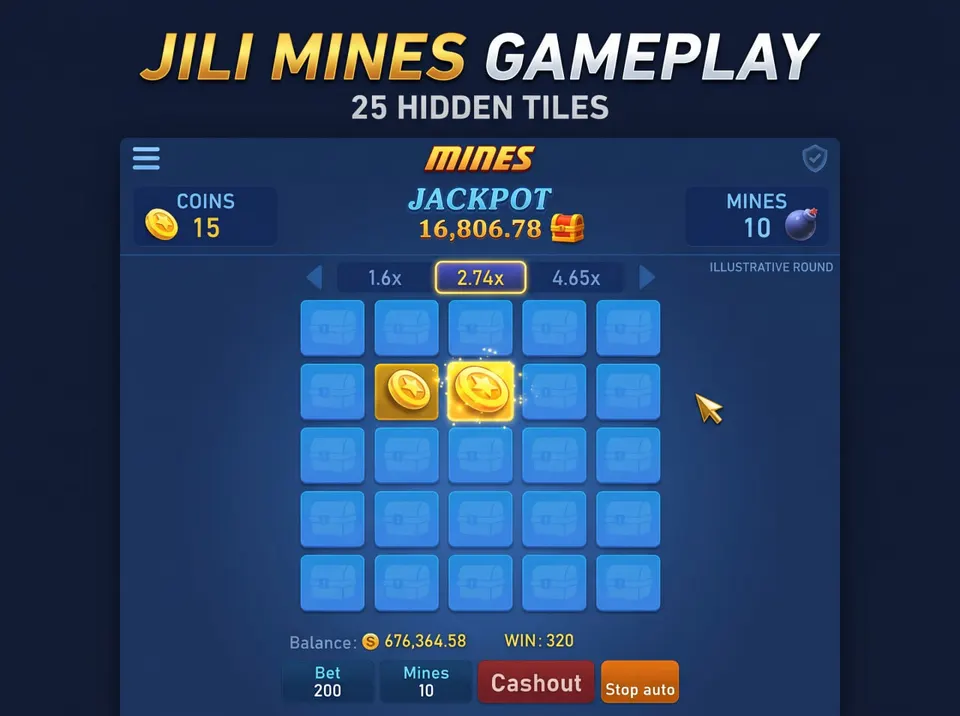
The board is divided into 25 square tiles arranged in five rows and five columns.
Before a tile is opened, it appears as a covered blue square.
When its contents are revealed, the image changes.
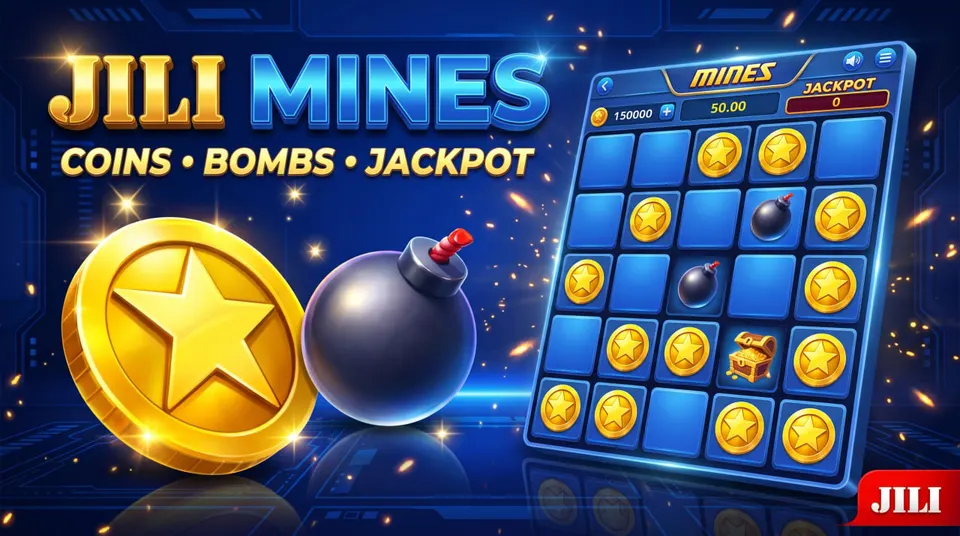
A safe tile displays a golden coin.
A dangerous tile displays a bomb.
At the top of the screen, the game can show information about the current Jackpot, remaining coins and mine count.
A row of multiplier values may appear above the grid.
Near the bottom, the interface includes controls for the amount, mine settings, Cashout and other available actions.
The result is a game that looks more like a digital tile puzzle than a traditional slot.
Why Does Mines Use a 5×5 Grid?
The 5×5 layout is central to the game's design.
There are five columns.
Each column has five tile positions.
That gives:
5 × 5 = 25 tiles.
The arrangement is easy to read on a mobile screen because every position has the same rectangular shape.
Unlike an ordinary slot, there is no need to follow winning symbols across separate reels.
The tile positions are initially concealed.
Each selected square reveals information about that specific position.
The grid remains the main visual focus throughout the round.
The actual outcome depends on which tiles conceal coins and which conceal bombs.
What Do the Gold Coin Symbols Mean?
Gold coins are the principal reward-related symbols in JILI Mines.
When a safe tile is revealed, it displays a coin.
The game's multiplier and current result can then change according to its defined rules.
In the original screenshot published by JILI, revealed coins appear as bright gold circular icons inside blue square positions.
This makes them stand out against the covered tiles.
A coin is different from a Jackpot symbol or an ordinary decorative graphic.
Its appearance indicates that the selected tile did not contain a bomb.
However, a previously revealed coin does not establish what lies beneath any remaining covered tile.
The other positions remain unknown until the relevant result information is revealed.
What Happens When a Bomb Appears?
Bombs represent the main hazard in the game.
The original JILI artwork shows them as dark rounded objects with a short fuse.
When a bomb is revealed, the current tile-selection round ends without a successful Cashout of that round's accumulated amount.
This creates the central difference between coins and bombs.
A coin is a safe reveal.
A bomb ends the round.
The game therefore uses only a few main symbols to create its basic interaction.
There is no requirement to match three identical objects across reels or activate a conventional slot payline.
The important information is whether the chosen tile contains a coin or a bomb.
What Does the Mine Count Change?
JILI allows the number of hidden mines to be selected before a round.
This setting affects the composition of the board.
The total number of tile positions remains 25.
But the number of tiles containing bombs changes.
If more positions contain bombs, fewer contain safe coins.
If fewer positions contain bombs, more safe tiles remain.
The developer's demonstration includes an example with ten mines.
On a 25-tile board, that creates the following composition:
10 bomb positions
15 coin positions
This is a useful example because it shows that both groups of symbols share the same 25-tile board.
The mine setting changes the distribution of safe and dangerous positions, not the physical size of the grid.
Example: A Board With Ten Mines
Consider a fictional JILI-style Mines round containing ten bombs and fifteen coins.
At the start, all 25 positions are covered.
The number of safe positions is 15.
The number of dangerous positions is 10.
For a uniformly shuffled layout, the probability that a randomly selected first tile contains a coin is:
15 ÷ 25 = 60%.
Now suppose the first selected tile contains a coin.
There are 24 unopened positions remaining.
Of those, 14 contain coins and ten contain bombs.
The conditional probability that the next randomly chosen unopened tile is also safe is:
14 ÷ 24 = approximately 58.33%.
The probability that two randomly chosen distinct tiles are both safe is:
(15 ÷ 25) × (14 ÷ 24) = 35%.
These calculations describe a hypothetical uniformly distributed board.
They do not establish the actual multiplier table, return settings or random implementation of a specific JILI deployment.
Most importantly, they do not identify which individual tiles are safe.
Why Do Multipliers Increase?
The game's multiplier system connects the number of successful coin discoveries to the amount displayed for the active round.
When a coin is revealed, the current multiplier can advance according to the selected mine configuration and the game's rules.
The idea is that different amounts of successful progression correspond to different multiplier levels.
The multiplier values also depend on the number of mines selected.
A screen configured with ten mines may display a different multiplier progression from a screen configured with four mines.
This is because the two configurations contain different numbers of safe positions.
A higher displayed multiplier must therefore be interpreted together with the conditions required to reach it.
It is not a guarantee of a future result.
What Does the Multiplier Display Show?
The original JILI Mines interface includes a row of multiplier values.
These values help explain how the active result is calculated after successful tile reveals.
In one of JILI's example screens, values such as 1.6×, 2.74× and 4.65× appear on the interface.
The screenshot demonstrates that the multiplier is not one fixed number for the entire game.
It changes across different stages.
However, those numbers belong to the demonstrated configuration.
They should not be presented as the universal multiplier sequence for every possible mine setting.
Different configurations can produce different values.
Readers examining Mines screenshots should therefore look at the mine count and the multiplier progression together.
What Is Cashout in JILI Mines?
Cashout is a core control in Mines.
After a successful coin reveal, the interface can display an amount available for collection.
Using Cashout ends the current round and collects the eligible displayed value under the game's rules.
That makes Cashout different from revealing another tile.
Revealing another tile continues the current round and exposes another hidden position.
Cashout ends the current round.
Both actions are visible in the interface, but they serve different purposes.
The available Cashout amount is also separate from an advertised maximum multiplier.
A current result should not be confused with the game's maximum theoretical outcome.
How Are Mines and Multipliers Connected?
The tile grid and multiplier display work together.
The grid contains hidden coins and bombs.
The multiplier reflects the current stage and game configuration.
The round can therefore be understood through three separate pieces of information.
First, the number of mines selected.
Second, the number of safe coins already revealed.
Third, the multiplier currently associated with that state.
These three elements explain much of what appears on the screen.
For example, an interface showing several revealed coins and a highlighted multiplier is presenting information about the current round.
It is not necessarily displaying a completed payout.
The status of Cashout matters when distinguishing a current amount from a collected result.
Why Does JILI Mines Have a Jackpot Display?
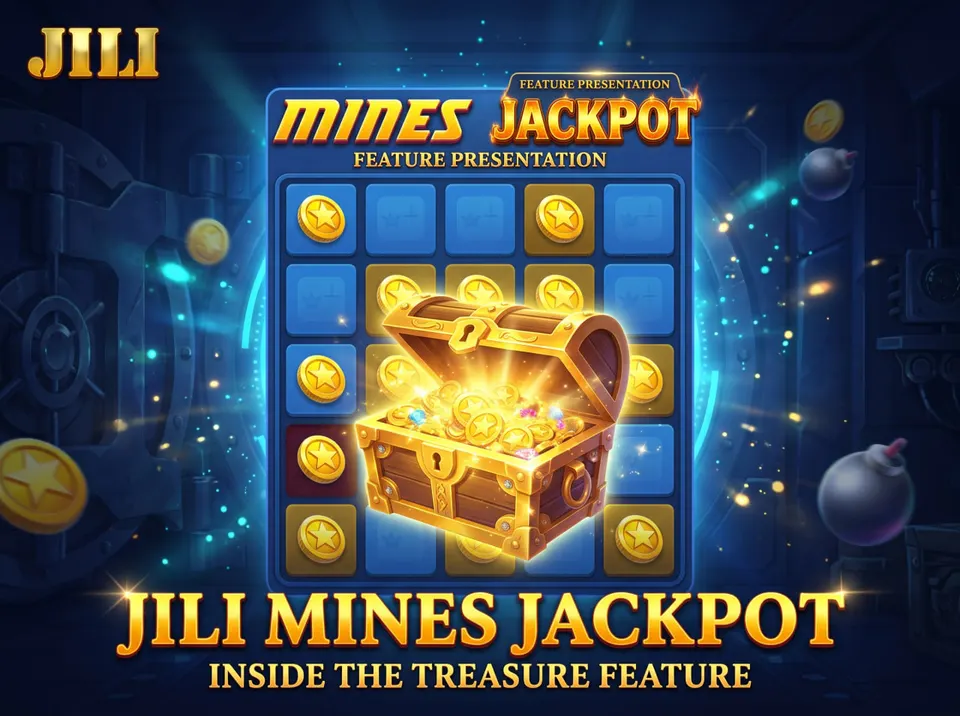
JILI officially lists Jackpots among the original Mines game's special features.
Its published gameplay screenshot also includes a Jackpot amount near the top of the screen.
The Jackpot is therefore part of the title's visible identity.
This is an important difference from a generic Minesweeper-style puzzle, which does not normally include a Jackpot system.
However, JILI's public product summary does not provide every underlying Jackpot trigger and calculation rule.
It would be inaccurate to claim that opening a particular square always activates a Jackpot or that a specific number of coins guarantees a bonus.
The actual Jackpot eligibility conditions belong to the game's full rules and the version being displayed.
For readers, the key point is that the Jackpot display is a separate feature from the ordinary coin-and-bomb tile reveal.
What Is the Treasure Chest Symbol?
JILI's official gameplay artwork includes a treasure chest on the tile grid.
Its appearance is consistent with the game's gold-and-treasure visual theme.
A chest graphic is visually different from the ordinary gold coin symbol.
But its exact eligibility conditions and effect should not be guessed from one screenshot.
For example, a chest may be associated with a special event or feature display, but the public product summary does not provide enough detail to assign a universal rule to every chest appearance.
It is therefore better to describe the chest as part of the game's special visual presentation, and leave its precise reward conditions to the relevant game information panel.
This avoids confusing a decorative or feature-related symbol with a guaranteed result.
How Does the Fairness Verification Work?
JILI's official Mines description states that each round can be verified using seeds from both parties.
This describes a result-verification approach rather than a method of predicting hidden coins.
In a seed-based verification system, information contributed by the relevant parties can be used to check the integrity of a completed result.
The exact steps depend on the implementation.
For example, a game may expose the relevant seed information after the round so the completed outcome can be checked.
However, the claim of verification does not mean that a reader can look at an unopened board and determine which tile contains a bomb.
A method for checking an already completed result is different from a method for discovering future or hidden outcomes in advance.
That distinction is essential when interpreting statements about fairness.
Can Previous Mines Results Reveal Safe Tiles?
A screenshot of a previous completed round cannot establish where the coins will appear in a new independent round.
Suppose a coin appeared in the upper-left corner of an earlier game.
That observation alone does not show whether the same position will be safe again.
Similarly, a bomb appearing in one location previously does not make that position safe in the next round.
The current round's hidden arrangement is what matters.
Old screenshots show historical results.
They do not supply a reliable map of an unopened future grid.
This is particularly important for a game with such a simple visual interface, because the grid can make patterns appear more meaningful than they actually are.
Is Mines a Slot Game?
JILI categorises the original Mines as a Crash game.
It is also commonly described as an instant or grid-based game.
The central interaction is different from a traditional slot.
A slot typically displays spinning reels and evaluates symbol combinations.
Mines reveals the contents of selected tiles.
Its multiplier system is tied to the tile-reveal format rather than ordinary paylines.
That is why Instant Games is the most suitable editorial category for the article on Wikipura.
For comparison, Super Ace by JILI uses a five-reel card-symbol system with Golden Cards and Joker features.
Although both titles come from JILI, their main game mechanics are completely different.
Mines vs Mines Gold
JILI also offers a separate title called Mines Gold.
The original Mines focuses on coins, bombs, adjustable mine counts and Jackpot presentation.
Mines Gold builds upon the treasure-digging concept with additional gold-related bonus features.
JILI's catalogue lists Mines Gold as a separate game published in June 2023.
That is one month after the original Mines catalogue publication.
The two games may share the concept of uncovering rewards while avoiding hidden hazards, but they should not be treated as identical products.
An article about Mines Gold should describe that game's own bonus mechanics rather than copying the original Mines rules and changing only the title.
Mines vs Mines Grand
Mines Grand is another separate JILI title.
According to the developer's catalogue, it was published in June 2025.
The game introduces a Treasure Pot feature.
This is an important distinction.
The original Mines lists Jackpots as a special feature.
Mines Grand advertises an accumulating Treasure Pot.
These names describe different products and should not be merged into one unverified feature description.
Their published maximum win figures also differ.
The original Mines advertises 10,000×.
Mines Grand lists a significantly higher theoretical maximum.
This makes accurate game-version identification important for readers researching either title.
Mines vs SPRIBE Mines
JILI is not the only developer with a game called Mines.
SPRIBE also offers a grid-based game with hidden safe tiles and mines.
Both use the general idea of selecting concealed positions.
But the artwork and specific rules are not necessarily identical.
JILI's original game uses a blue grid, gold coin illustrations, bomb icons and a Jackpot display.
SPRIBE's version is commonly shown with stars and mine symbols.
The games also have their own published multiplier settings and interface controls.
Therefore, an RTP percentage, mine-count limit or special feature described for one developer should not automatically be attributed to another.
The full title and developer are useful identifiers.
This article is about JILI Mines, not SPRIBE Mines.
How Does Mines Compare With Vortex?
Mines and Vortex are both discussed within the broader instant-games category, but their interfaces differ greatly.
Mines uses a rectangular grid containing hidden coins and bombs.
Vortex uses three concentric elemental rings representing Fire, Earth and Water.
Mines progressively reveals the contents of selected tiles.
Vortex updates its elemental progression tracks according to the game's own symbol rules.
Both contain multiplier-related information.
But the way that information is displayed and calculated is different.
This difference is useful when comparing instant-game design because it shows how developers can build visually distinct products without using the ordinary slot-reel format.
What Makes JILI Mines Recognisable?
Several details give Mines its identity.
The first is the bright blue 5×5 grid.
The second is its gold coin reward symbol.
The third is its dark bomb icon.
The fourth is the ability to configure the number of mines.
The fifth is the multiplier display connected to successful tile reveals.
The sixth is the Cashout control.
Finally, the original game's Jackpot header and treasure-themed artwork make it more distinctive than a simple puzzle interface.
Together, these elements create a recognisable JILI game.
The design is minimal compared with visually elaborate slots, but it still contains several separate pieces of information.
Is JILI Mines Designed for Mobile?
JILI distributes games through HTML5-based technology and describes support for mobile devices.
The Mines grid is particularly suited to a touch interface because the main interaction uses individual square positions.
Each square is visually separated from its neighbours.
The coin and bomb symbols are also relatively easy to distinguish.
However, the exact layout of the controls can vary according to the game implementation and the size of the screen.
A mobile screenshot may position the grid, multiplier display and Cashout controls differently from a desktop interface.
This does not necessarily mean the underlying game is a different title.
It may simply be a different presentation of the same game.
What Does the Advertised 10,000× Maximum Mean?
JILI's official catalogue advertises a maximum win of 10,000× for the original Mines.
This is a theoretical maximum associated with the game.
It is not the standard multiplier for a normal round.
It also does not mean that opening a certain fixed number of coins will necessarily produce that result.
The maximum must be interpreted according to the full game rules.
It should also be kept separate from the current Jackpot display.
A maximum multiplier is a published upper figure.
A Jackpot amount is a feature-related display whose eligibility and calculation follow other conditions.
They are different pieces of information.
Does JILI Publish a Universal RTP for Mines?
The official JILI product summary reviewed for this article provides the game type, Jackpot feature, publication period, maximum advertised win and verification description.
It does not clearly publish a universal RTP percentage for all deployments of the original Mines.
Some independent websites list their own RTP figures.
However, those figures should not be presented as official without matching them to the exact game configuration.
For that reason, this article does not assign an unsupported RTP percentage.
Readers interested in understanding the difference between a theoretical return figure and variation in results can explore Wikipura's RTP and Volatility explanation.
The general mathematical distinction is useful even though that article uses slot examples.
Frequently Asked Questions About JILI Mines
What is Mines by JILI?
Mines is a grid-based instant game developed by JILI Games, featuring hidden coins, bombs, selectable mine counts, multipliers and Cashout controls.
Who developed Mines?
The game was developed by JILI Games.
When was JILI Mines released?
JILI's catalogue lists May 2023 as its publication period.
Does JILI Mines use slot reels?
No. Its main interface is a grid of covered tiles, not traditional spinning reels.
How many tiles are in the game?
The original gameplay interface uses a 5×5 grid with 25 tile positions.
What do the gold coins mean?
Coins represent safe reward-related reveals within the game's tile system.
What happens if a bomb is revealed?
A bomb ends the active round without its uncollected accumulated amount being paid.
Can the number of mines be changed?
Yes. JILI describes a selectable mine count, although the exact available settings must be checked in the game interface.
What does Cashout mean?
Cashout collects the available eligible amount and ends the current tile-selection round.
Does JILI Mines have a Jackpot?
Yes. JILI lists Jackpots among the original game's special features and displays Jackpot information in its official gameplay artwork.
What does the treasure chest do?
The official screenshot includes a chest graphic, but the public product summary does not establish one universal trigger or reward condition for it.
Does the game have a maximum advertised win?
JILI lists a maximum of 10,000× for the original Mines.
What is seed-based fairness verification?
It is a method for checking a completed result using information supplied through the game's verification system. It is not a way to discover future hidden tiles.
Is Mines Gold the same game?
No. Mines Gold is a separate JILI title with additional bonus-related features.
Is Mines Grand the same game?
No. Mines Grand is a later JILI title that advertises a Treasure Pot feature.
Is JILI Mines the same as SPRIBE Mines?
No. The two games share a broad tile-reveal concept but come from different developers and can have different settings and features.
Is Mines specifically an Indian game?
No. It is an international JILI product. This article is written in English for readers in India researching the title.
Can a previous round show where the next safe coins will appear?
A previous result does not establish the position of safe tiles in a new independent round.
Explore More Game Information on Wikipura
JILI Mines shows how an instant game can use a relatively small set of symbols while providing a distinctive interactive layout.
Instead of traditional slot reels, the screen focuses on hidden information beneath square tiles.
The coin, bomb, multiplier and Jackpot displays each communicate a different part of the game's rules.
For comparisons with reel-based titles, readers can visit Wikipura's Slot Games category.
For other game articles and topics, browse the Wikipura homepage.
Final Thoughts
Mines by JILI is a recognisable instant game because of its blue tile grid, hidden coins and bombs, adjustable mine settings and Cashout interface.
Its original gameplay is different from both traditional slot games and multiplier-ring games such as Vortex.
The current board contains information that is gradually revealed through tile selections.
A successful coin reveal changes the active result, while a bomb ends the round.
The game also includes Jackpot-related presentation and a seed-based result-verification system described by JILI.
For readers researching the title, the most useful distinction is understanding exactly which Mines game is being discussed.
The original JILI Mines, Mines Gold, Mines Grand and SPRIBE Mines are separate products.
Recognising the developer, game version, symbols and feature descriptions provides a clearer picture of the game than treating every product called Mines as identical.
Editorial note: Game features are based on the original JILI Mines catalogue and accompanying gameplay materials. Mathematical examples are illustrative and do not represent recorded results or guaranteed outcomes.