Super Ace by JILI: Golden Cards, Jokers & Game Features
Discover Super Ace by JILI, a card-themed slot game featuring Golden Cards, Joker Wilds, 1,024 winning ways and cascading combinations. Explore its distinctive symbols, multiplier system, Free Games and mobile-friendly interface in this detailed game overview for Indian readers.
In this article
- What Is Super Ace by JILI?
- Super Ace Game Information at a Glance
- Who Developed Super Ace?
- What Does the Super Ace Game Look Like?
- Understanding the Five-Reel Layout
- What Does 1,024 Ways Mean in Super Ace?
- What Symbols Appear in Super Ace?
- Regular Playing Cards
- Golden Cards
- Joker Symbols
- Scatter Symbols
- What Is the Golden Card Feature?
- How Does a Golden Card Become a Joker?
- Little Joker vs Big Joker in Super Ace
- Little Joker
- Big Joker
- What Happens After Winning Symbols Disappear?
- What Is the Super Ace Combo Multiplier?
- Example: How Consecutive Multipliers Work
- What Is the Free Game Feature in Super Ace?
- How Do Free Game Multipliers Differ?
- Can the Free Game Add More Spins?
- Super Ace vs Super Ace 2: Are They the Same Game?
- Super Ace vs Super Ace Deluxe
- Super Ace vs Super Ace Joker
- Is Super Ace Available on Android?
- Why Super Ace Is Different From Fortune Tiger
- Does Super Ace Have a Guaranteed Winning Pattern?
- What About Super Ace RTP and Volatility?
- Frequently Asked Questions About Super Ace
- What is Super Ace by JILI?
- Who developed Super Ace?
- When was Super Ace released?
- How many reels does Super Ace have?
- What does 1,024 ways mean in Super Ace?
- What is the Golden Card feature?
- Where can Golden Cards appear?
- What is a Golden Joker in Super Ace?
- What is the difference between Little Joker and Big Joker?
- Does Super Ace have cascading combinations?
- What are the normal game multipliers?
- What are the Free Game multipliers?
- How is the Free Game triggered?
- Is Super Ace the same as Super Ace 2?
- Is Super Ace the same as Super Ace Joker?
- Is Super Ace available on mobile?
- Can players predict Super Ace results?
- Explore More Slot Games on Wikipura
- Final Thoughts
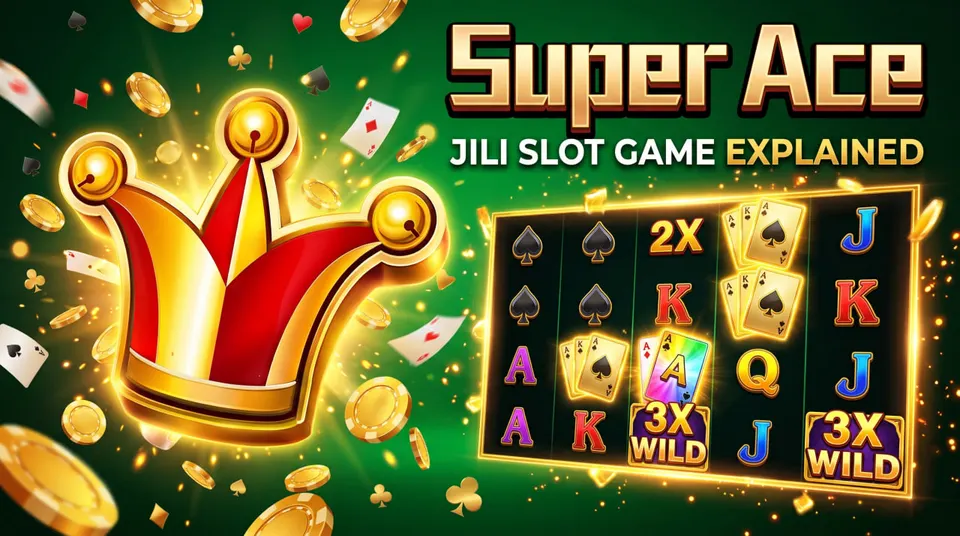
Super Ace is a card-themed slot game developed by JILI Games, featuring colourful playing-card symbols, Golden Cards, Joker Wilds and a distinctive combination system. Unlike traditional slot games built around fruits, animals or treasure chests, Super Ace brings the familiar appearance of playing cards into a modern five-reel game.
The game appears in mobile gaming catalogues alongside other JILI titles such as Fortune Gems, Money Coming and Crazy 777. Its visual identity is easy to recognise: a striking Joker crown, bold card symbols and a green-and-gold presentation.
But the appearance is only one part of the game.
Super Ace also includes a Golden Card transformation feature, consecutive winning combinations, increasing multipliers and a separate Free Game mode.
This article explores the original Super Ace game by JILI, including its screen layout, card symbols, Joker mechanics, bonus features and differences from other games in the same series.
What Is Super Ace by JILI?
Super Ace is a video slot developed by JILI Games and released in August 2020, according to the developer's published catalogue.
It is built around playing-card imagery and a special symbol-elimination system.
The game uses five reels with four visible rows, creating a grid of twenty symbol positions.
Instead of relying on a small number of traditional fixed paylines, Super Ace uses a system described as 1,024 ways to form qualifying combinations.
The main attraction is the interaction between ordinary playing cards, Golden Cards and Joker symbols.
When certain qualifying Golden Cards are involved in winning combinations, they can transform into Joker symbols. These special symbols then affect how subsequent combinations are evaluated.
The game also includes a combo multiplier that changes during consecutive winning stages.
These mechanics give Super Ace a different identity from smaller three-reel games.
Super Ace Game Information at a Glance
Here are the main characteristics of the original Super Ace.
Developer: JILI Games.
Original release: August 2020.
Game format: Video slot.
Reel layout: Five reels and four rows.
Winning system: 1,024 ways.
Special symbols: Golden Cards, Joker symbols and Scatters.
Main features: Symbol elimination, consecutive combinations, multiplier progression and Free Game.
Listed volatility: Low to medium in JILI's catalogue.
Main visual theme: Playing cards, Joker imagery, green backgrounds and golden details.
These specifications refer to the original Super Ace. Related titles such as Super Ace 2, Super Ace Deluxe and Super Ace Joker have additional features and should not be treated as identical games.
Who Developed Super Ace?
Super Ace was created by JILI Games, a studio with a catalogue covering video slots and several other types of digital games.
JILI has developed titles with very different visual themes.
Some feature gemstones and lucky wheels.
Others feature fishing adventures, animals, mythology or card symbols.
Super Ace belongs to the card-themed side of this catalogue.
One distinctive aspect of the game is how it uses familiar playing cards as part of an animated reel system.
Instead of presenting ordinary static playing cards, the game transforms them into colourful digital symbols with golden effects and special Joker interactions.
Its presentation feels closer to an arcade-style mobile game than to a conventional card table.
That difference is important because Super Ace is not a traditional game of poker or rummy. Its playing-card designs are symbols within a reel-based game, evaluated according to Super Ace's own rules.
What Does the Super Ace Game Look Like?
Super Ace has a colourful and recognisable visual style.
The game uses a five-column symbol grid surrounded by decorative interface elements.
Green and gold are prominent colours, giving the screen a bright appearance.
Playing-card symbols occupy the main grid.
A Joker-themed character and crown imagery appear in the game's promotional presentation.
The interface is designed to make the special card effects visible.
When qualifying combinations occur, selected symbols can disappear and be replaced. Golden Cards can also transform into Joker symbols under the game's rules.
This creates a changing screen rather than one static arrangement.
Readers who are familiar with ordinary fruit-based slots will notice that Super Ace places greater emphasis on the transformation of card symbols.
The Joker is therefore part of both the game's visual branding and its main feature system.
Understanding the Five-Reel Layout
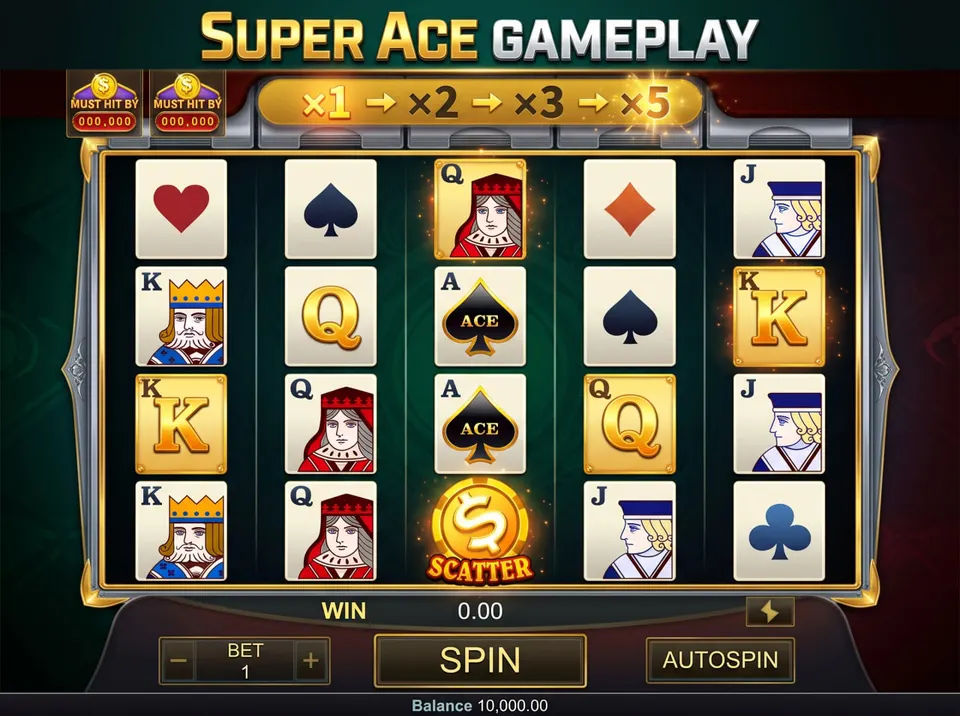
The original Super Ace uses five reels and four visible rows.
That produces a total of twenty positions.
The layout can be imagined as five vertical columns, each containing four visible symbols.
From left to right, the reels are numbered one through five.
The game evaluates combinations according to its defined winning-ways system.
This is different from a basic three-reel title such as Fortune Tiger.
Fortune Tiger uses a compact three-by-three grid and five fixed paylines.
Super Ace has a larger symbol area and 1,024 ways to form qualifying combinations.
Both are slot games, but their screen structures are not the same.
For a separate look at JILI's three-reel alternatives, readers can also explore Wikipura's Slot Games collection.
What Does 1,024 Ways Mean in Super Ace?
The term “1,024 ways” refers to the number of possible symbol-position routes in the game's defined reel arrangement.
With four visible positions across five reels, the basic mathematical count is:
4 × 4 × 4 × 4 × 4 = 1,024.
That is where the number comes from.
However, having 1,024 potential ways does not mean that all those ways produce winning combinations.
A qualifying result still needs to satisfy the game's symbol-matching rules.
For example, several eligible card symbols may need to appear across consecutive reels from the left.
The actual combination is determined by the game's evaluation system, not simply by counting every card that appears on the screen.
For this reason, it is useful to distinguish between the number of theoretical position routes and the number of combinations that actually qualify.
Super Ace's winning-ways system is an identifying feature, but it is not a prediction system.
What Symbols Appear in Super Ace?
Super Ace takes its visual identity from familiar playing-card imagery.
Its ordinary symbols include card ranks and suits commonly seen in a deck of playing cards.
Some are presented in standard form, while others have special golden versions.
The main symbol groups can be understood as follows.
Regular Playing Cards
The ordinary card symbols form the main visual language of the game.
Cards such as Ace, King, Queen and Jack help make the layout instantly recognisable.
The game also uses suit-related symbols.
These ordinary card images are evaluated according to the game's defined symbol values and combination rules.
Their appearance does not mean the game follows standard poker-hand rules.
Super Ace has its own reel-based evaluation system.
Golden Cards
Golden Cards are special versions of eligible regular card symbols.
They are important because they can participate in a transformation mechanic.
Rather than being merely decorative, a qualifying Golden Card can produce a Joker symbol after the relevant elimination stage.
This makes Golden Cards one of the most recognisable features of Super Ace.
Joker Symbols
Jokers are associated with the game's Wild-style symbol mechanics.
They can influence the evaluation of ordinary card combinations after being created through the Golden Card feature.
Their effect is different from the basic meaning of an ordinary playing card.
Scatter Symbols
Scatter symbols are connected to the game's Free Game feature.
Their role is separate from the ordinary card combinations.
That distinction matters because not every special symbol follows the same evaluation rules.
What Is the Golden Card Feature?
The Golden Card mechanic is central to Super Ace.
In the original game's documented rules, Golden Cards appear on the middle three reels: Reels 2, 3 and 4.
They represent golden versions of ordinary playing-card symbols.
When a Golden Card participates in a qualifying winning combination, it can be removed through the game's elimination process.
The Golden Card then transforms into a Joker symbol.
This is what makes the feature distinctive.
The Golden Card is not simply a decorative gold version of a regular symbol. Its transformation can affect subsequent stages of the same sequence.
To understand the difference, imagine a screen containing an ordinary King card and a Golden King card.
Both may be treated as the corresponding card symbol when the game evaluates an eligible combination.
But the Golden Card has an additional transformation role when its required condition is satisfied.
This extra effect distinguishes it from the ordinary symbol.
How Does a Golden Card Become a Joker?
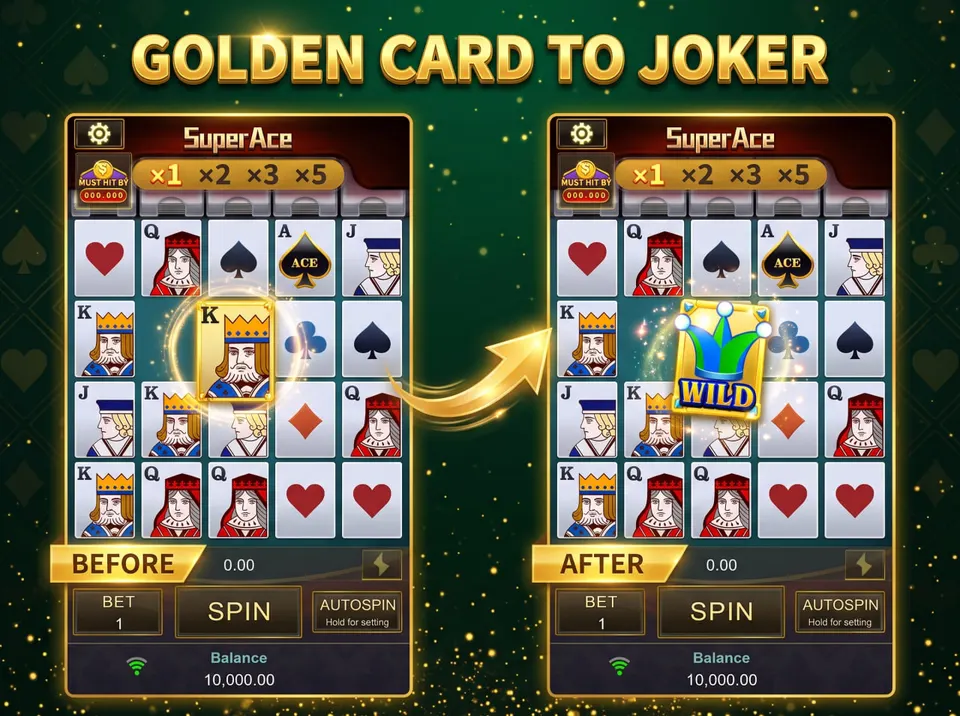
The process begins when a Golden Card is involved in a qualifying combination.
The game evaluates that combination.
Then the symbols associated with the result undergo the elimination sequence.
When the Golden Card's transformation condition is met, the game reveals a Joker symbol.
That Joker can influence subsequent symbol combinations within the same ongoing sequence.
This creates a connection between two mechanics:
First: a Golden Card participates in a qualifying combination.
Second: a Joker appears as part of the resulting transformation.
The precise effect depends on the particular Joker form.
This is why understanding the Golden Card feature requires knowing the difference between the two Joker types.
Little Joker vs Big Joker in Super Ace
Super Ace includes two Joker forms commonly described as Little Joker and Big Joker.
Although both belong to the game's special card mechanics, they do not behave identically.
Little Joker
The Little Joker represents a more localised transformation.
When the relevant Golden Card is converted, the Little Joker occupies the corresponding position.
This makes it visually easy to follow which part of the grid was affected.
Its effect belongs to the card transformation and symbol-evaluation system.
Big Joker
The Big Joker can have a wider influence on the grid.
Published descriptions of the original game explain that it may change additional eligible symbol positions into Joker symbols.
The effect can involve several positions rather than only the original Golden Card location.
However, the game's rules restrict which positions and symbols can be affected.
For example, Scatters and existing Joker symbols are not treated as ordinary replacement targets.
The important takeaway is that the two Joker forms can have different scopes.
One may affect a single original position, while the other can introduce a broader Joker transformation.
These mechanics are specific to Super Ace and should not automatically be applied to every JILI game.
What Happens After Winning Symbols Disappear?
Super Ace uses an elimination system.
When qualifying card combinations are evaluated, the corresponding symbols can be removed.
The game then introduces replacement symbols into the grid.
The updated arrangement is evaluated again.
If the new arrangement contains another qualifying combination, the process can continue.
This creates consecutive winning stages within one initial activation.
The sequence ends when the applicable evaluation produces no further qualifying combination.
The visual effect is one reason Super Ace feels different from a simple static reel game.
The screen can change repeatedly as cards disappear and new symbols arrive.
It also provides the foundation for the game's combo multiplier.
What Is the Super Ace Combo Multiplier?
Super Ace includes a multiplier that progresses during consecutive qualifying stages.
The original game's published rules describe four multiplier levels in the normal game:
1× → 2× → 3× → 5×
The multiplier begins at the first level.
When additional qualifying combinations occur through the ongoing elimination sequence, the game can move to the next level.
This means separate stages of one sequence may be evaluated with different multiplier values.
However, the multiplier does not keep rising indefinitely.
It follows the defined progression and resets when the sequence ends under the game's rules.
The feature is therefore different from simply multiplying every result by the highest displayed value.
Example: How Consecutive Multipliers Work
Consider a fictional illustration using four qualifying stages.
The following numbers are invented to demonstrate the calculation and do not represent actual Super Ace results.
Suppose the first stage has a base prize value of two units.
At 1×, that becomes two units.
The second stage also has a base value of two units.
At 2×, that becomes four units.
The third stage has a base value of one unit.
At 3×, that becomes three units.
The fourth stage has a base value of two units.
At 5×, that becomes ten units.
The combined illustrated amount is:
2 + 4 + 3 + 10 = 19 units.
This example demonstrates why consecutive winning stages and multiplier progression should be considered together.
But it is not a formula for determining when those stages will occur.
In the actual game, results depend on the defined symbol combinations and game mathematics.
What Is the Free Game Feature in Super Ace?
The original Super Ace also includes a Free Game mode.
Published game-rule descriptions state that three or more qualifying Scatter symbols can activate a feature awarding ten free spins.
The Free Game uses the same general card-combination structure as the normal game, but the multiplier progression is different.
Additional qualifying Scatters during the Free Game can also add spins according to the feature's rules.
This gives the bonus mode its own identity rather than presenting exactly the same multiplier sequence as the normal game.
The word “free” here refers to feature spins awarded under the game's mechanics. It should not be interpreted as a guarantee that a feature will produce a particular prize.
How Do Free Game Multipliers Differ?
The multiplier progression changes in the Free Game.
The original published rules describe these four levels:
2× → 4× → 6× → 10×
Compare that with the normal game's progression:
1× → 2× → 3× → 5×
Each corresponding multiplier level is doubled during the Free Game.
For instance, the first multiplier level changes from 1× to 2×.
The next changes from 2× to 4×.
The highest listed combo level increases from 5× to 10×.
This is an important distinction between the two modes.
It also explains why the JILI catalogue specifically highlights double multipliers in the Free Game.
However, a higher multiplier does not guarantee that a qualifying combination will occur.
The multiplier affects the calculation when the corresponding feature conditions are satisfied.
Can the Free Game Add More Spins?
In published descriptions of the original Super Ace rules, additional Scatters appearing during the Free Game can award extra spins.
For example, a further qualifying set of three Scatters can add five more feature spins.
The extra spins can accumulate according to the game's rules.
This is often described as a retrigger.
A retrigger is different from starting an unrelated ordinary spin.
It adds to or extends the current special feature.
The exact counter and animation should be checked against the version displayed by the game.
This matters because other games carrying the Super Ace name may introduce different feature variations.
Super Ace vs Super Ace 2: Are They the Same Game?
No.
JILI has published several titles using the Super Ace name.
The original Super Ace was released in August 2020.
Super Ace 2 is a later title with its own product listing and additional features.
The original game focuses on Golden Card transformations, Joker mechanics, elimination sequences and its characteristic multiplier progression.
JILI describes Super Ace 2 as introducing a Stacked Golden Joker mechanic.
That means the newer game builds upon the earlier theme rather than simply presenting the same title under a different name.
The similarities can make screenshots look related, but the two should be treated as separate products.
When researching a particular feature, it is important to check the complete game title.
Super Ace vs Super Ace Deluxe
Super Ace Deluxe is another title in the same general family.
It retains playing-card imagery but introduces additional feature behaviour.
Descriptions of Deluxe include an expanded Golden Card system and a Star Card mechanic.
These are not features that should automatically be attributed to the original Super Ace.
The distinction matters for readers comparing different game catalogues.
If a screenshot shows a Star Card feature, that may indicate a different Super Ace version.
If the game description focuses on the original Golden Card and Joker transformation, it may be discussing the earlier title.
Product names should therefore be kept separate in SEO content.
Combining every feature from the series into one article would create an inaccurate impression of the original game.
Super Ace vs Super Ace Joker
Super Ace Joker is also a separate JILI title.
Its catalogue description includes Golden Symbols, multiplier effects and Mystery Symbols.
Those details distinguish it from the original Super Ace.
Although the games share Joker imagery, the particular symbol systems and advertised features can differ.
The original Super Ace's main identity is the relationship between Golden Cards, Joker transformations and the consecutive-win multiplier.
That is the game being explained in this article.
The existence of other Super Ace variants provides useful context, but their individual features should not be presented as original-game rules.
Is Super Ace Available on Android?
Super Ace is presented in mobile-oriented game catalogues, and published game information lists Android and HTML5 support for the original title.
A five-reel grid with four rows is compatible with a portrait-style mobile interface.
Its bold playing-card artwork is also designed to remain recognisable at relatively small display sizes.
However, availability can differ between gaming platforms, devices and regions.
Seeing Super Ace in one mobile game catalogue does not establish that it is available from every service in India.
It is also important to distinguish a game within a platform from an unrelated file claiming to be a standalone Super Ace application.
The product title and software source should be checked separately.
Why Super Ace Is Different From Fortune Tiger
Super Ace and Fortune Tiger are useful examples of how two mobile slot games can take very different approaches.
Super Ace uses five reels and four rows.
Fortune Tiger uses three reels and three rows.
Super Ace focuses on playing cards, Golden Cards and Joker transformations.
Fortune Tiger focuses on a golden tiger, prosperity-themed symbols and a retained-symbol respin feature.
Super Ace has a sequence of increasing combo multipliers associated with its elimination mechanics.
Fortune Tiger includes a different special feature and an x10 condition tied to its own rules.
These differences are more meaningful than trying to label one game universally better.
Both titles have distinct visual identities and different mechanical structures.
For a separate look at the tiger-themed game, see Fortune Tiger Slot Game Explained for Indian Players.
Does Super Ace Have a Guaranteed Winning Pattern?
No verified game information establishes a guaranteed way to predict Super Ace outcomes from previous symbol sequences.
A Golden Card appearing during one result does not prove that another will appear next.
A Joker transformation does not mean that the next independent activation must produce another qualifying combination.
Likewise, reaching a particular combo multiplier in one sequence does not establish how the following sequence will behave.
The game has defined mechanics, but understanding those mechanics is not the same as predicting random results.
The most reliable descriptions concern the way symbols are evaluated and features operate, rather than unsupported claims about specific future outcomes.
What About Super Ace RTP and Volatility?
JILI's original game catalogue describes Super Ace as having low-to-medium volatility.
However, the catalogue entry reviewed for this article does not clearly establish a single verified RTP percentage for every available version.
For that reason, this article does not assign an unverified RTP number to the game.
It is also important not to confuse volatility with theoretical return.
RTP describes a game's expected long-term average return according to its mathematical model.
Volatility describes how much results may vary.
These are different characteristics.
For an example of why two games with the same theoretical return can have different result distributions, read Why Two Slot Games With the Same RTP Can Feel Different.
Frequently Asked Questions About Super Ace
What is Super Ace by JILI?
Super Ace is a playing-card-themed video slot developed by JILI Games, featuring Golden Cards, Joker symbols, symbol elimination, increasing multipliers and a Free Game mode.
Who developed Super Ace?
The game was developed by JILI Games.
When was Super Ace released?
JILI's catalogue lists the original game as published in August 2020.
How many reels does Super Ace have?
The original Super Ace uses five reels and four visible rows.
What does 1,024 ways mean in Super Ace?
It describes the game's winning-ways arrangement based on the available positions across its five-reel grid. It does not mean that every possible route produces a qualifying result.
What is the Golden Card feature?
Golden Cards are special card symbols that can transform into Joker symbols after participating in qualifying winning combinations.
Where can Golden Cards appear?
Published descriptions of the original game specify the middle three reels: Reels 2, 3 and 4.
What is a Golden Joker in Super Ace?
It is a special Joker symbol associated with the Golden Card transformation mechanic.
What is the difference between Little Joker and Big Joker?
Little Joker is associated with a localised Golden Card transformation, while Big Joker can have a broader effect on eligible symbol positions according to the game's rules.
Does Super Ace have cascading combinations?
Yes. Its elimination system can remove qualifying symbols, introduce replacements and evaluate the updated grid.
What are the normal game multipliers?
The original game's published rules describe levels of 1×, 2×, 3× and 5×.
What are the Free Game multipliers?
The Free Game progression is described as 2×, 4×, 6× and 10×.
How is the Free Game triggered?
Published descriptions of the original game state that three or more qualifying Scatter symbols can activate a Free Game awarding ten spins.
Is Super Ace the same as Super Ace 2?
No. Super Ace 2 is a separate JILI title that introduces additional mechanics.
Is Super Ace the same as Super Ace Joker?
No. Super Ace Joker has its own game listing and additional feature descriptions.
Is Super Ace available on mobile?
Published game information identifies support for Android and HTML5, although actual availability varies by platform.
Can players predict Super Ace results?
The published feature rules do not establish a reliable method for predicting future results from previous outcomes.
Explore More Slot Games on Wikipura
Super Ace is one of several card-themed and character-driven slot titles that can be examined through their actual game features.
Its combination of Golden Cards, Joker transformations and progressive multiplier stages makes it different from games based on fishing, lucky wheels or three-reel animal themes.
Readers interested in other game titles can explore Wikipura's Slot Games category.
The category also covers subjects such as reel mechanics, symbol behaviour and game mathematics.
Final Thoughts
Super Ace by JILI is more than a slot game decorated with playing cards.
Its design connects Golden Cards, Joker symbols, symbol elimination and combo multipliers into a recognisable feature system.
The five-reel layout and 1,024 ways distinguish it visually from smaller three-reel titles.
The Golden Card transformation creates a memorable connection between ordinary symbols and special Joker effects.
Meanwhile, the changing multiplier progression gives consecutive combinations a different calculation from isolated single-stage results.
For Indian readers researching the game, these details provide a clearer understanding of what Super Ace actually is and how the original version differs from later releases such as Super Ace 2, Deluxe and Joker.
The central idea is simple: Super Ace's identity comes from the interaction between its card symbols and special features, not from any supposed guaranteed pattern.
Understanding those features is the most useful starting point for anyone who wants to learn about the game.