Wingo Colour Trading Number Chart 0–9: Results Guide
Discover how Wingo colour trading and number charts from 0-9 can boost your betting strategy in India with insights and practical tips.

In this article
- What Is Wingo Colour Trading and Its Number Chart?
- Wingo Colour Trading Number Chart: All Digits from 0 to 9
- Why Do 0 and 5 Have Two Colours?
- What Do Big and Small Mean in Wingo?
- How to Read a Wingo Result Step by Step
- How to Understand a Wingo Number Chart History
- Does a Pattern in the 0–9 Chart Predict the Next Number?
- Understanding Frequencies Without Falling for Predictions
- Common Mistakes When Reading Wingo Colour Trading Charts
- Wingo Colour Trading and Indian Online Gaming Rules in 2026
- How to Check a Wingo Chart More Carefully
- Frequently Asked Questions About Wingo Colour Trading
- What is Wingo colour trading?
- What is the Wingo colour trading number chart?
- Which numbers are Red in Wingo?
- Which numbers are Green in Wingo?
- Why is number 0 shown in two colours?
- Why is number 5 called Big?
- Can past colour trends guarantee a future result?
- Are all WinGo apps using the same rules?
- Is Wingo colour trading legal in India in 2026?
- What should beginners learn first?
- Final Summary
Wingo colour trading uses a number chart to explain results from 0 to 9. The chart shows which colour and size label belongs to each number, but it does not predict what will appear in the next round.
This 2026 guide explains how to read the chart, check result history, and avoid misleading claims about winning patterns.
What Is Wingo Colour Trading and Its Number Chart?
In a common WinGo-style format, a round ends with one result number between 0 and 9. That number is associated with a colour such as Red, Green, or Violet and a size label called Big or Small. A number chart is simply a reference showing those relationships.
The expression “colour trading” can be misleading. This is not stock trading, foreign exchange trading, or a marketplace for buying and selling coloured products. In games involving stakes, it refers to choosing an outcome before a timed result is revealed. Wikipura explains the chart for educational purposes, not as financial advice or a recommendation to participate in a money game.
If you are new to the terminology, read our What Is Wingo Game? beginner guide before exploring the number chart.
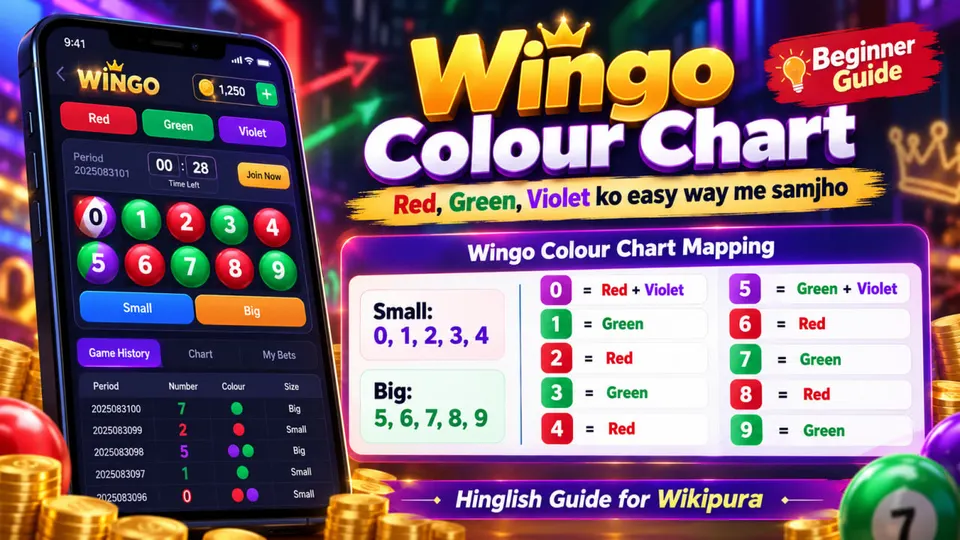
Wingo Colour Trading Number Chart: All Digits from 0 to 9
The following is a commonly used WinGo-style mapping. It is not proof that every website or app follows identical rules. Always refer to the rules displayed by the particular version you are examining.
- 0 — Red + Violet — Small
- 1 — Green — Small
- 2 — Red — Small
- 3 — Green — Small
- 4 — Red — Small
- 5 — Green + Violet — Big
- 6 — Red — Big
- 7 — Green — Big
- 8 — Red — Big
- 9 — Green — Big
These ten entries are all you need to interpret the basic colour and size labels in this format. For an explanation focused specifically on each colour, see the Wingo Red, Green and Violet chart.
Why Do 0 and 5 Have Two Colours?
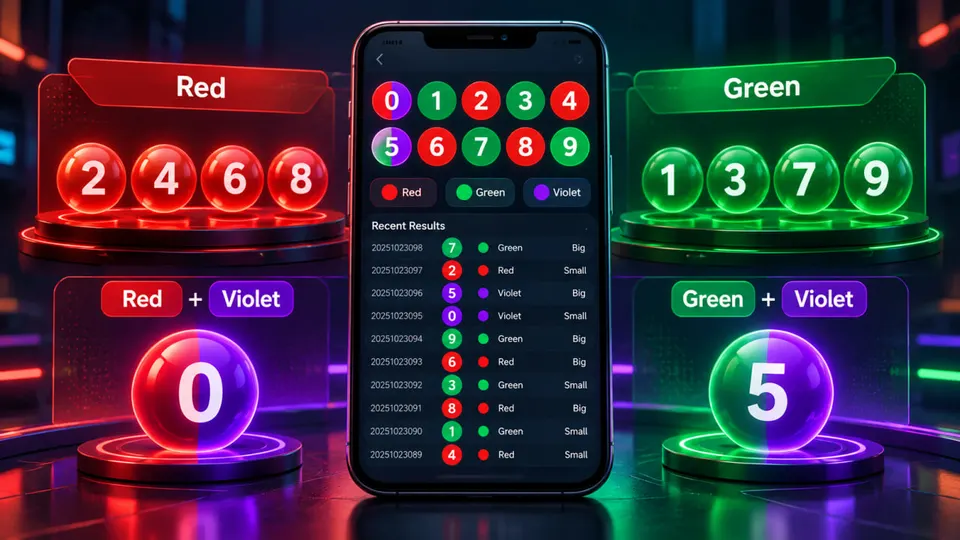
Numbers 0 and 5 are special in many versions of the chart. Zero can carry the labels Red and Violet, while five can carry Green and Violet. That is why a results page may display two colours next to a single digit.
For example, a round that ends on 0 is still one result, not two separate results. The number is 0, its size is Small, and its displayed colour labels may be Red + Violet.
The same idea applies to a result of 5. Its size is Big and its colour labels may be Green + Violet. How a particular platform evaluates selections involving those colours is determined by that platform's published rules; the chart itself does not establish a payout or guarantee fairness.
What Do Big and Small Mean in Wingo?
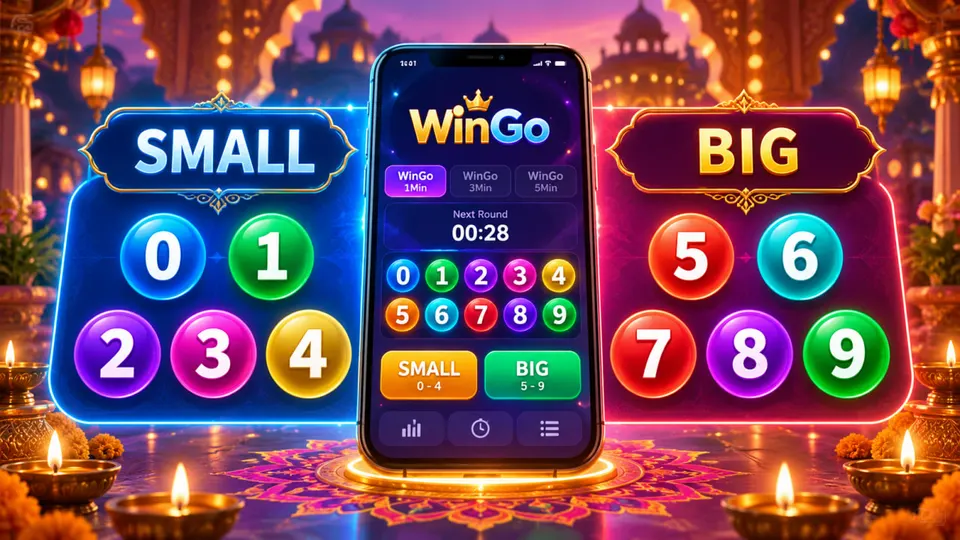
Big and Small classify the result number, not how much money is involved or how important a round is.
Small numbers: 0, 1, 2, 3, and 4.
Big numbers: 5, 6, 7, 8, and 9.
A result of 4 is Red and Small. A result of 7 is Green and Big. A result of 5 is Big even though it is the midpoint of the 0–9 range. These labels are easy to confuse when a mobile interface shows only a coloured circle, so start by checking the digit itself.
How to Read a Wingo Result Step by Step
Imagine a result-history page shows a completed round with the number 8. Here's how to interpret it:
- Find the period ID. This identifies the completed round, so you do not confuse it with the previous or next one.
- Read the result number. In this example, it is 8.
- Check the colour chart. Number 8 belongs to Red.
- Check the size label. Number 8 belongs to Big because it falls between 5 and 9.
- Confirm the round is complete. A pending timer or provisional screen is not the same as a final published result.
Now consider a completed round showing 0. The result number is 0, the colour labels are Red + Violet, and the size is Small. No additional calculation is required.
Some interfaces use dots or abbreviated letters instead of full words. In that case, use the page's own legend to confirm what the display means. Do not assume the same icon has an identical meaning across unrelated websites.
How to Understand a Wingo Number Chart History
A result history usually lists several completed rounds in order. Depending on the interface, each row may show a period number, a result digit, a colour label, and a Big or Small indicator. This is a record of what happened, not an instruction for the next round.
Consider the following illustrative example, which is not a real-time feed:
- Round A: 2 — Red — Small
- Round B: 7 — Green — Big
- Round C: 0 — Red + Violet — Small
- Round D: 5 — Green + Violet — Big
You can use the chart to verify that all four rows have consistent labels. You cannot use these four outcomes to know whether the next digit will be Red, Green, Violet, Big, or Small.
For help understanding timers and round identifiers, refer to the Wingo rounds and results guide.
Does a Pattern in the 0–9 Chart Predict the Next Number?
No reliable prediction follows from the chart alone. A run of Red results, a missing digit, or repeated Big results describes past rounds. It does not establish the next result.
If a game generates each number independently, the previous sequence does not change the next outcome's probability. Seeing Red four times in a row does not mean Green must follow. Similarly, a digit that has not appeared for several rounds is not automatically “due.” This mistaken assumption is commonly called the gambler's fallacy.
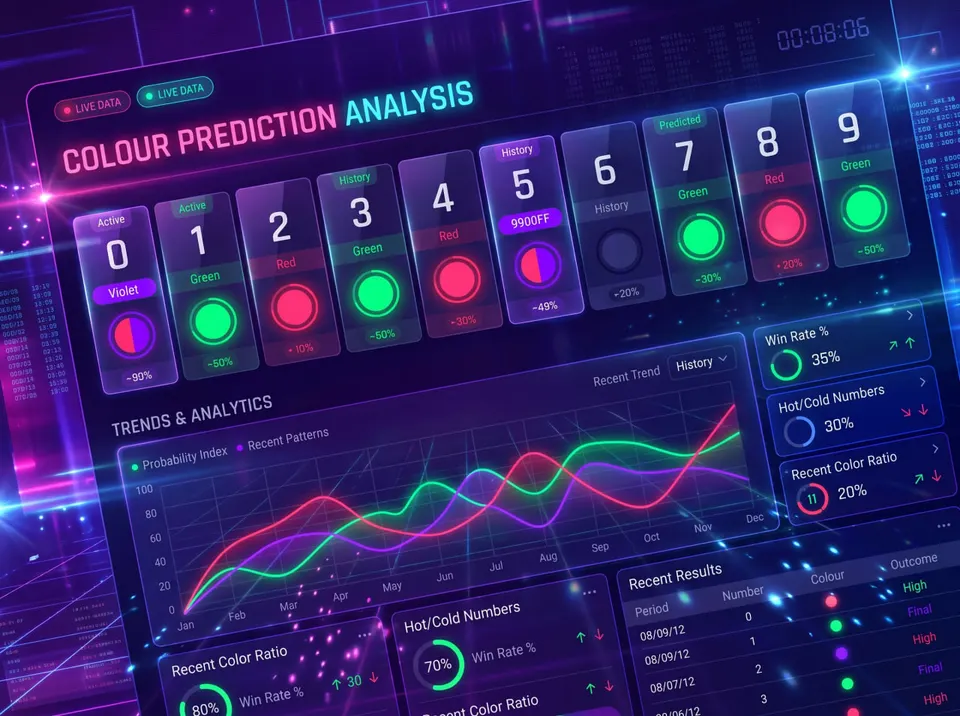
It is also important not to assume a platform is fair merely because it displays a history chart. A trustworthy assessment would require evidence about how outcomes are generated, recorded, and independently reviewed. A colourful interface or a claimed prediction accuracy percentage is not enough.
Understanding Frequencies Without Falling for Predictions
A chart can still answer useful historical questions. For instance, it can show how many times a particular digit appeared in a specific sample, or whether a colour label was displayed more often during the rounds you recorded.
Suppose a sample contains 20 completed results and digit 3 appears four times. It is reasonable to say that digit 3 occurred four times in that sample. It is not reasonable to claim that digit 3 now has a guaranteed higher chance of appearing again.
Small samples can produce clusters and streaks by chance. Even a large sample cannot prove that an unverified game's future outcomes are predictable. Treat frequencies as historical descriptions, not signals or investment advice.
Common Mistakes When Reading Wingo Colour Trading Charts
Mistake 1: Using the wrong number-to-colour mapping. A chart showing Blue, Yellow, Pink, or Black for all ten numbers does not match the Red, Green and Violet format described here.
Mistake 2: Forgetting dual-colour digits. Zero may appear as Red + Violet and five as Green + Violet. Those rows still represent one result each.
Mistake 3: Treating Big and Small as extra outcomes. Both labels are derived from the same 0–9 result, not from a second independent draw.
Mistake 4: Mixing results from different periods. A screenshot without a visible round ID can be outdated or misleading.
Mistake 5: Believing in guaranteed colour patterns. Repeated outcomes can happen without creating a predictive rule.
Mistake 6: Trusting paid “prediction tools” without evidence. Screenshots, testimonials, and accuracy claims are not substitutes for independently verifiable results.
Wingo Colour Trading and Indian Online Gaming Rules in 2026
Readers in India should distinguish between learning about a chart and participating in a real-money game. The Promotion and Regulation of Online Gaming Act, 2025, and the Promotion and Regulation of Online Gaming Rules, 2026, established a national framework that came into force on 1 May 2026.
Under this framework, online money games meeting the legal definition are prohibited, while permitted social games and e-sports are treated differently. Classification depends on factors such as payments or stakes and expectations of monetary winnings; it is not determined by a game's name alone.
The Ministry of Electronics and Information Technology has explained the rules and classification process in its official 2026 online gaming rules announcement. Wikipura does not verify or endorse the legal status, licensing, payouts, or security of any specific colour prediction platform.
A website's accessibility and a claim of being “official” should not be taken as evidence that money gaming is lawful or safe.
How to Check a Wingo Chart More Carefully
Use this quick checklist whenever you read a number chart or a screenshot:
- Check which specific game or platform the chart describes.
- Confirm that the result is final rather than pending.
- Find the round or period identifier.
- Read the number before reading its colour.
- Check whether 0 and 5 have dual-colour labels.
- Separate Big/Small classifications from colour labels.
- Compare screenshots with the platform's own published legend.
- Treat previous results as history, not future predictions.
- Avoid websites asking for deposits or personal details merely to reveal a supposed “guaranteed” pattern.
This approach helps readers understand the display while avoiding unsupported claims and unnecessary security risks.
Frequently Asked Questions About Wingo Colour Trading
What is Wingo colour trading?
Wingo colour trading is a term commonly used for colour-and-number prediction games. In a common format, each completed round produces a digit from 0 to 9 with an associated colour and size label. It is not financial-market trading.
What is the Wingo colour trading number chart?
It is a reference that links digits 0–9 with Red, Green and Violet labels and the Big/Small classification. Its purpose is to explain results, not forecast the next round.
Which numbers are Red in Wingo?
In the commonly used format, 2, 4, 6 and 8 are Red. Zero is associated with Red and Violet together.
Which numbers are Green in Wingo?
The Green group usually includes 1, 3, 7 and 9. Five is associated with Green and Violet together.
Why is number 0 shown in two colours?
Zero is a special entry in many WinGo-style charts, where it carries Red and Violet labels. It remains one result and belongs to the Small group.
Why is number 5 called Big?
The usual classification is Small for 0–4 and Big for 5–9. Number 5 is therefore Big and may carry Green + Violet labels.
Can past colour trends guarantee a future result?
No. The history of earlier rounds does not guarantee the next digit, colour, or size. Claims of certain predictions should be treated sceptically.
Are all WinGo apps using the same rules?
Not necessarily. This guide explains a common mapping, but interfaces, mechanics, and settlement rules can differ. Check the specific platform's published documentation.
Is Wingo colour trading legal in India in 2026?
The legal answer depends on the specific activity and whether it meets the definition of a prohibited online money game. India's national online gaming framework came into force on 1 May 2026. Do not assume that a website is lawful simply because it is accessible.
What should beginners learn first?
Start with the ten result digits, the special cases 0 and 5, and the Big/Small split. Then learn to read a completed period's result. These basics are more useful than memorising alleged winning patterns.
Final Summary
A Wingo colour trading number chart is useful for interpreting historical results. In a common format, 0–9 determine Red, Green and Violet labels, with 0 and 5 carrying two colour labels and Big/Small determined by the number range. The chart can make result screens easier to understand, but it cannot establish a winning strategy, verify a platform's fairness, or predict the next round.
This guide is educational and does not recommend participation in real-money gaming. For Indian readers, always consider the current rules and official government guidance before interacting with any money gaming service.