How Wingo Colour Prediction Rounds Work: Timer & Results
Understand how Wingo colour prediction rounds work, including countdown timers, period IDs, result numbers, colour labels, and common mistakes.
In this article
- How Wingo Colour Prediction Rounds Work
- What Is a Wingo Period Number?
- Understanding the Countdown Timer
- Does a faster round change the probability?
- How the Result Number, Colour and Size Fit Together
- Small Numbers (0 to 4)
- Big Numbers (5 to 9)
- How to Read a Wingo Result History Table
- Worked example: reading a single result
- Do Previous Wingo Results Predict the Next Round?
- Common Mistakes When Reading the Game Screen
- 1. Confusing the current timer with a completed result
- 2. Treating Violet as a stand-alone digit
- 3. Assuming every WinGo-branded interface is identical
- 4. Believing that patterns guarantee the next result
- 5. Trusting screenshots without checking the source
- 6. Assuming a colourful interface means a service is legitimate
- Troubleshooting Result and Timer Display Problems
- Is Wingo Colour Prediction Legal in India in 2026?
- Frequently Asked Questions
- What is a Wingo colour prediction round?
- What does the timer mean in Wingo?
- What is a period number in Wingo?
- Are Red, Green and Violet used in every version?
- What is the difference between Big and Small?
- Does a history chart tell you the next colour?
- Why do numbers 0 and 5 sometimes show two colours?
- Can I use a prediction bot to know the next result?
- Are real-money Wingo games allowed in India?
- Final Takeaway
Wingo colour prediction rounds are short, timed game cycles in which a number is shown at the end of each period. That number is associated with a colour and, in many versions, a Big or Small label.
Understanding the countdown, round identifier and result history helps readers interpret the screen correctly. It does not make future results predictable.
Quick answer: A typical WinGo-style round displays a period ID and countdown timer. Once the selection window closes, the system displays a result number from 0 to 9. The game then applies its published colour and Big/Small rules to that number. Exact timings, interfaces and settlement rules vary by operator.
This independent explainer describes common interface conventions; it does not recommend any operator or encourage real-money participation. India has prohibited online money games under legislation brought into force in May 2026. See the legal information below.
How Wingo Colour Prediction Rounds Work
A round, sometimes called a period, is one complete cycle of the game. The screen commonly shows its identifying number, the time remaining and the eventual outcome. The result of one period should not be confused with the result of another.
Here is the usual sequence:
- A new period appears. The interface displays an ID or period number so the round can be distinguished from earlier ones.
- A countdown begins. The timer indicates how long the current period has left. The window for making selections may close before the timer reaches zero.
- The period closes. After the deadline, its result is determined and displayed according to the operator's rules.
- The outcome appears. Many WinGo-style games show a single digit between 0 and 9, a colour indicator and a Big or Small label.
- The history updates. The completed period is added to the list of earlier results, and a new round begins.
The process may look slightly different on different platforms. Some show a wheel animation, others display numbered balls or a simple results table. Visual effects alone do not demonstrate how the underlying outcome was generated.
What Is a Wingo Period Number?
The period number, or round ID, identifies a particular game cycle. It helps readers associate a displayed outcome with the correct round. Some interfaces use long numeric identifiers, while others combine dates and sequence numbers.
Here is a simple example of three completed periods:
- Example-101: The result number is 3. Its colour is Green, and its size label is Small.
- Example-102: The result number is 8. Its colour is Red, and its size label is Big.
- Example-103: The result number is 5. Its colour labels are Green and Violet, and its size label is Big.
These are fictional examples used to explain the interface, not actual WinGo results.
When reviewing a results page, first confirm that the period ID and game duration match the information you intended to read. Two screens showing different periods are not necessarily displaying conflicting results.
Understanding the Countdown Timer
The countdown indicates the progress of the current round. It should not be mistaken for a prediction signal.
WinGo-style interfaces may use short and longer periods, sometimes labelled 30 seconds, 1 minute, 3 minutes or 5 minutes. These are examples found on certain platforms, not a universal timetable for every version of WinGo.
Three timing details are important:
- Round duration: The stated length of a full period.
- Selection cutoff: The point at which the interface stops accepting changes. This may be earlier than the result display.
- Result publication: The moment the number and related labels become visible after the round finishes.
A slow internet connection, a stale browser tab or a delayed refresh may cause the timer or result to appear late. Such display delays should not be treated as evidence of a different result or as clues about the next number.
Does a faster round change the probability?
A shorter countdown does not, by itself, make a particular number more likely. It simply means rounds occur more frequently. Rapid cycles can also make it harder to pause and assess spending or time, which is one reason to be cautious with money-based versions.
How the Result Number, Colour and Size Fit Together
In a commonly documented WinGo-style format, the result is a digit from 0 to 9. A predefined mapping turns that digit into its visible colour label, while a separate rule assigns Big or Small.
Here is the common mapping, written as a simple list for easy reading.
Small Numbers (0 to 4)
- 0 — Red and Violet (Small)
- 1 — Green (Small)
- 2 — Red (Small)
- 3 — Green (Small)
- 4 — Red (Small)
Big Numbers (5 to 9)
- 5 — Green and Violet (Big)
- 6 — Red (Big)
- 7 — Green (Big)
- 8 — Red (Big)
- 9 — Green (Big)
This list explains a common format, not a verified rulebook for every site using the WinGo name. Check the rules for the exact version being described. Some interfaces label a special number with two colours, which is why 0 and 5 need particular attention.
For a deeper explanation of the basic mapping, see Wikipura's separate Wingo Colour Prediction Game Rules guide.
How to Read a Wingo Result History Table
A result history is a record of outcomes that have already been displayed. Its purpose is to help readers understand what happened, not to forecast what comes next.
When looking at a result history screen, check these five details:
- Period or issue number: Identifies the completed round. Make sure it matches the round you want to review.
- Result number: Shows the digit produced in that round. In the format explained here, this is a number from 0 to 9.
- Colour: Shows the label associated with the number. Compare it with the rules used by that particular version.
- Big or Small: Classifies the number. In the common format, 0–4 means Small and 5–9 means Big.
- Result time: Shows when the outcome was displayed. Check whether the page is current or showing an older cached result.
Some sites additionally offer coloured dots, trend charts, streak counters or frequency summaries. These are different visualisations of past records. They do not establish that future outcomes follow a predictable sequence.
Worked example: reading a single result
Suppose the displayed result is 8.
- The outcome number is 8.
- Under the common mapping above, its colour label is Red.
- Because 8 lies between 5 and 9, its size label is Big.
- The period ID tells you which completed round produced that result.
Now suppose the next completed period shows 0.
- The outcome number is 0.
- In the same format, the colour indicators are Red and Violet.
- The size label is Small.
The second outcome does not prove that the first one caused it. The two rows are simply consecutive historical records.
Do Previous Wingo Results Predict the Next Round?
No reliable prediction follows from the previous results alone when rounds are independent. People naturally notice runs of the same colour or alternating patterns. Those observations can be interesting descriptions of history, but they are not evidence that a particular result is due next.
For example, five consecutive Red results do not mean Green must appear next. This is a version of the gambler's fallacy, the mistaken belief that an independent random outcome must balance recent results over a short period.
Similarly, a result history that appears unusually repetitive is not enough, by itself, to prove manipulation or fairness. Evaluating the fairness of an operator would require credible information about its random-number generation, operating controls and independent audits. Do not assume that a platform is audited simply because it says its results are random.
Common Mistakes When Reading the Game Screen
1. Confusing the current timer with a completed result
A live round and the latest completed round are separate. Make sure the history table has updated before treating the newest displayed number as final.
2. Treating Violet as a stand-alone digit
In the common mapping used above, Violet is linked with special numbers 0 and 5. It is not a separate number outside the 0–9 range.
3. Assuming every WinGo-branded interface is identical
Different sites may use different labels, durations or settlement terms. A screenshot from one provider should not be represented as universal instructions for another.
4. Believing that patterns guarantee the next result
Repeated colours, missing numbers and streak charts summarise earlier outcomes. They do not provide a guaranteed method for predicting a future independent draw.
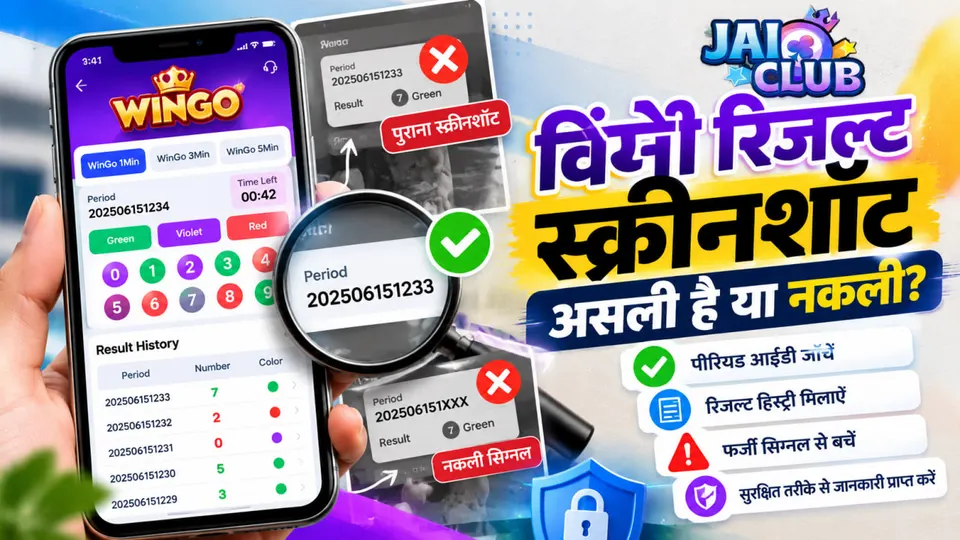
5. Trusting screenshots without checking the source
A screenshot may be old, edited or taken from an unrelated game. Verify the displayed period, time and origin before sharing claims about results.
6. Assuming a colourful interface means a service is legitimate
A polished app screen is not proof of legal compliance, fair outcomes or data security. Be particularly wary of requests for identity documents, banking details or app installations from unverified sources.
Troubleshooting Result and Timer Display Problems
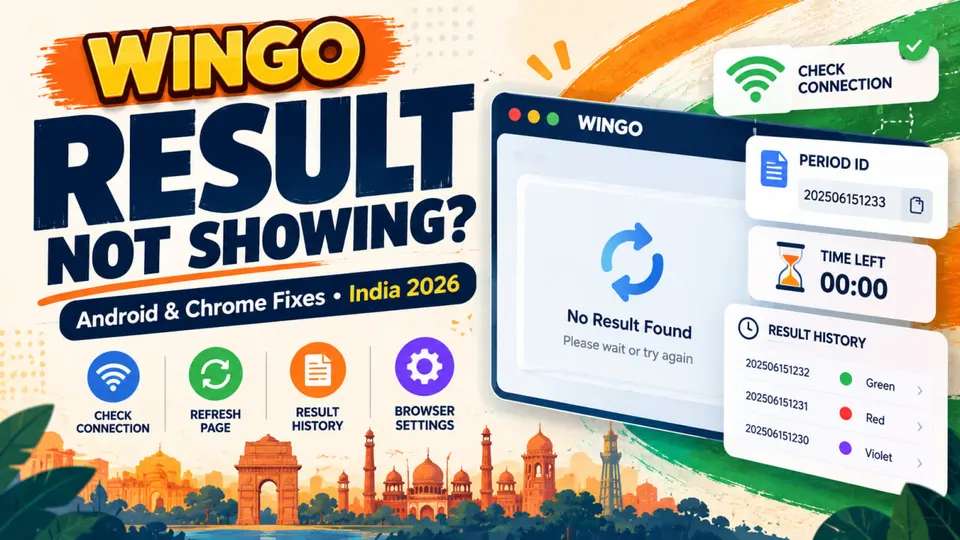
If a result appears missing or the interface looks out of date, a few non-financial checks may help distinguish a display issue from an actual change:
- Confirm the period ID. The latest result in history may belong to the preceding period.
- Refresh carefully. A stale page or interrupted internet connection can delay visible updates.
- Check your device clock. An incorrect clock can make displayed times confusing, even if the site uses its own server clock.
- Compare the interface's own history. If different pages show conflicting information, note the period IDs and timestamps rather than assuming one is correct.
- Avoid unverified tools. Third-party “prediction” APKs, bots or result-modifying scripts may be misleading or unsafe.
These checks explain what may be happening on screen. They do not validate the security or reliability of a particular game provider.
Is Wingo Colour Prediction Legal in India in 2026?
India's Promotion and Regulation of Online Gaming Act, 2025, implemented through rules that came into force on 1 May 2026, prohibits online money games. The government describes the prohibition as covering games of chance, skill or combinations of the two when they fall within the legal definition of an online money game.
This distinction matters because a game described as “skill-based” is not automatically lawful when it involves prohibited money stakes and monetary returns. Non-money online social games and recognised e-sports are treated differently under the framework, subject to the applicable criteria and rules.
The legal classification of a particular service depends on how that service operates. Wikipura does not verify that any WinGo-branded platform is lawful or authorised. This article is educational and does not provide instructions for deposits, wagering or withdrawals.
Government reference: Ministry of Electronics and Information Technology — Promotion and Regulation of Online Gaming Rules, 2026.
Frequently Asked Questions
What is a Wingo colour prediction round?
It is one timed game cycle. At the end of a period, a result number and its corresponding labels are displayed according to the version's rules.
What does the timer mean in Wingo?
It shows how far the current period has progressed. The selection window may close before the visible timer ends, depending on the platform.
What is a period number in Wingo?
A period number is an identifier for a particular round. It helps distinguish the outcome of one cycle from another.
Are Red, Green and Violet used in every version?
They are common in the WinGo-style formats covered here. Exact labels and rules must be checked against the particular version being discussed.
What is the difference between Big and Small?
In a common 0–9 version, Small means 0–4 and Big means 5–9. This describes the result classification, not a claim about which outcome will occur next.
Does a history chart tell you the next colour?
No. A history chart records earlier outcomes. If the underlying draws are independent, previous colours do not reliably predict the next one.
Why do numbers 0 and 5 sometimes show two colours?
Some popular WinGo-style rule sets associate 0 with Red and Violet and 5 with Green and Violet. Always verify the mapping for the specific game version.
Can I use a prediction bot to know the next result?
There is no credible guarantee that a bot or pattern-based tool can predict an independent draw. Be cautious of tools requesting login credentials, financial information or unverified downloads.
Are real-money Wingo games allowed in India?
India's national online-gaming framework, effective from 1 May 2026, prohibits online money games. Whether a specific service meets the statutory definition depends on its operation. Readers should consult official government guidance rather than rely on promotional claims.
Final Takeaway
The simplest way to understand Wingo colour prediction is to separate the period ID, the countdown and the completed result. A number from 0 to 9 may be shown with colour and Big/Small labels according to the applicable rules. Historical charts help explain what has already appeared, but they do not guarantee what comes next.
For more on colour and number classifications, read Wikipura's Wingo Colour Prediction Game Rules. For information about Indian online-gaming law, refer to the official government source linked above.