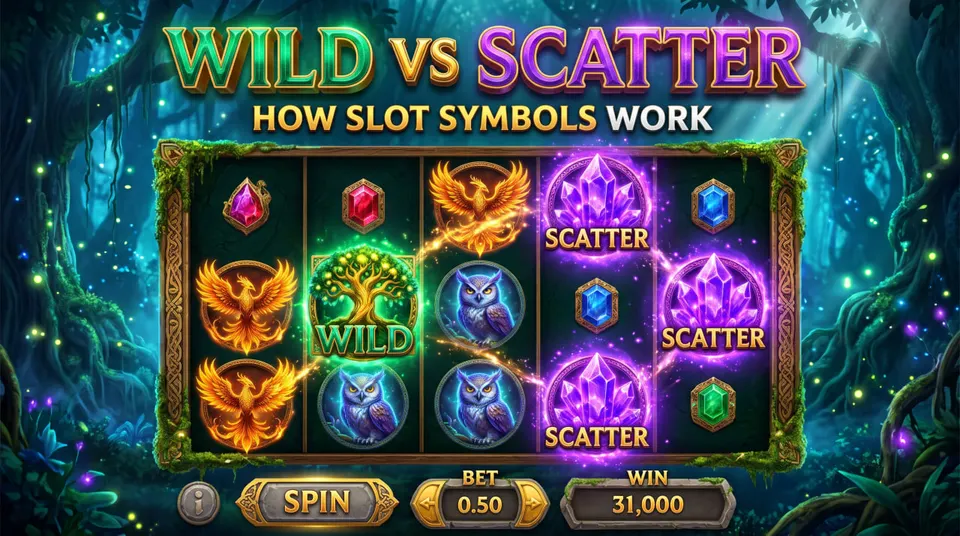
Wild vs Scatter Symbols: Why They Behave Differently
Wild and Scatter symbols may look similar, but they serve different purposes in slot games. Explore how Wild substitutions, Scatter combinations, bonus symbols, expanding Wilds, and special features work with practical examples.
In this article
- Wild vs Scatter Symbols: Why They Behave Differently
- What Is a Wild Symbol?
- What Is a Scatter Symbol?
- The Main Difference Between Wild and Scatter
- Example 1: How a Wild Completes a Payline
- Example 2: How Scatter Symbols Can Work
- Can Wild Symbols Replace Scatter Symbols?
- Can Scatter Symbols Award Prizes Without Activating a Bonus?
- What Are Expanding Wilds?
- What Are Sticky Wilds?
- What Are Moving and Stacked Wilds?
- What Are Scatter Multipliers?
- How Wilds and Scatters Interact With Cascading Reels
- Wild vs Scatter vs Bonus Symbol
- Why Symbol Names Can Be Misleading
- Common Mistakes When Reading Wild and Scatter Symbols
- How to Understand a Slot Symbol Paytable
- Frequently Asked Questions About Wild and Scatter Symbols
- What is the difference between Wild and Scatter?
- Can a Wild replace any symbol?
- Does a Scatter have to land on a payline?
- Can a Scatter pay without a bonus feature?
- Can Wild and Scatter appear together?
- What is an Expanding Wild?
- What is a Sticky Wild?
- Can Scatters appear during a cascade?
- Is a Scatter the same as a Bonus symbol?
- Do Wilds guarantee more frequent prizes?
- Final Thoughts
- Related Wikipura Articles
Wild vs Scatter Symbols: Why They Behave Differently
Wild and Scatter are two of the most recognisable symbols in slot games, but they do not usually perform the same function.
A Wild symbol commonly substitutes for another symbol to complete a qualifying combination. A Scatter symbol often follows a separate rule, potentially counting toward a feature or award without requiring a conventional payline.
However, the exact behaviour depends on the game. Some titles use expanding Wilds, sticky Wilds, paying Scatters, special symbol restrictions, and unusual combinations of these mechanics.
This article explains how Wild and Scatter symbols work, why they are different, and what to look for when reading a slot game's symbol rules.
What Is a Wild Symbol?
A Wild is a special symbol that commonly acts as a substitute for one or more ordinary symbols.
For example, imagine a fictional slot game containing fruit symbols such as apples, lemons, and cherries.
Suppose the game awards a qualifying combination when three or more matching apples appear along a defined active payline.
A Wild may replace a missing apple within that combination.
Instead of requiring:
Apple – Apple – Apple
The game may accept:
Apple – Wild – Apple
In this situation, the Wild represents an apple for the purpose of evaluating the combination.
This is a simplified example. Individual slot games can define different requirements for the number of matching symbols, which symbols can be substituted, and how the combinations are counted.
The important idea is that Wild symbols often help complete another symbol's combination.
What Is a Scatter Symbol?
A Scatter is a special symbol whose effect is usually defined separately from ordinary symbol combinations.
In many slot formats, Scatter symbols can count toward a feature when they appear in certain numbers or positions.
For example, a fictional game might award a bonus feature when three Scatter symbols appear anywhere on the grid during the same completed activation.
Unlike a normal payline-based combination, the Scatters would not necessarily have to appear next to one another.
That does not mean every Scatter automatically counts from every position.
Some games specify eligible reels, minimum counts, special game modes, or particular symbol locations.
A Scatter's real function must therefore be confirmed from the game's symbol information.
The Main Difference Between Wild and Scatter
The most common distinction is straightforward.
Wild symbols help form qualifying symbol combinations.
Scatter symbols often activate separately defined awards or special features.
For a typical payline game, the Wild influences how ordinary combinations are evaluated.
A Scatter may instead be counted through a different mechanism that does not depend on an ordinary matching-symbol line.
This is why a Wild and a Scatter can appear on the same grid while being evaluated under different rules.
Neither symbol is automatically more valuable or more likely to appear simply because of its name.
Example 1: How a Wild Completes a Payline
Let's construct a fictional five-reel game.
Assume a qualifying award requires at least three matching Apple symbols in a consecutive left-to-right sequence on an active payline.
Now imagine the visible sequence is:
Apple – Apple – Wild – Lemon – Cherry
If this game's rules allow Wilds to substitute for Apples, the first three positions can form a three-Apple combination.
The Wild effectively fills the third position in that combination.
But imagine a slightly different sequence:
Apple – Lemon – Wild – Apple – Cherry
There may be no qualifying Apple combination along that same left-to-right payline, depending on the game's rules.
The Wild's presence does not automatically turn every scattered group of Apples into a paying combination.
Position and combination requirements still matter.
This is why a Wild icon should be interpreted alongside the game's payline or ways-to-win rules.
Example 2: How Scatter Symbols Can Work
Now consider a different fictional game.
Its rules say:
Three or more Scatter symbols appearing anywhere on the five reels activate a special feature.
Suppose the visible grid contains a Scatter on Reel 1, another on Reel 3, and a third on Reel 5.
Those symbols are not positioned next to one another.
Under the fictional rule we defined, the feature still activates because three Scatters appeared in qualifying locations.
This is different from the Apple payline example.
The Scatter rule depends on the symbol count rather than a continuous line of ordinary matching symbols.
But consider another game that accepts Scatters only on Reels 1, 3, and 5.
In that version, the exact locations would matter.
The lesson is that “Scatter” describes a family of special-symbol mechanics, not one universal rule.
Can Wild Symbols Replace Scatter Symbols?
In many traditional slot formats, Wilds can substitute for ordinary paying symbols but do not substitute for Scatters or dedicated bonus symbols.
However, this is not an absolute rule across every game design.
A particular title may introduce a special Wild that interacts with a bonus mechanic or another feature symbol.
To understand the actual behaviour, check whether the game's paytable explicitly says the Wild substitutes for:
- All regular paying symbols.
- Only selected regular symbols.
- Special symbols as well.
- Certain symbols only in a bonus mode.
If the instructions do not say that Wilds replace Scatters, it is not safe to assume they do.
A useful principle is to read symbol substitution rules literally rather than relying on the visual similarity between games.
Can Scatter Symbols Award Prizes Without Activating a Bonus?
Yes, depending on the game's rules.
Some Scatters award a prize when a particular number appears, even if a separate feature is not activated.
Other games use them only to trigger a special round.
Still others combine multiple effects, such as a Scatter-based prize and a feature activation.
The number required for each effect may differ.
For example, a fictional game might award a small Scatter prize for two symbols but activate an additional feature when four appear.
There is nothing contradictory about that design. It simply uses different thresholds for separate outcomes.
The symbol description and paytable should explain the difference.
What Are Expanding Wilds?
An Expanding Wild is a version of the Wild symbol that changes its coverage when a defined condition is met.
For instance, a Wild might appear in one position and expand to cover an entire reel.
Depending on the design, it may then substitute for ordinary symbols in several positions.
However, an expanding animation does not automatically mean every covered position creates a qualifying combination.
Normal rules about paylines, matching symbols, active features, and substitutions may still apply.
The visual expansion describes what happens to the symbol. The actual result depends on how the game evaluates the completed grid.
What Are Sticky Wilds?
Sticky Wilds remain in selected positions for a defined number of subsequent events.
For example, a game might keep a Wild in place during a series of additional feature spins.
That can change how future grids are evaluated within that feature.
But the word “sticky” does not tell us the duration on its own.
A Sticky Wild might remain for two spins, the rest of a feature, or another period defined by the game.
It also does not mean that ordinary future results are predetermined.
The exact persistence and substitution rules determine the feature's behaviour.
What Are Moving and Stacked Wilds?
Some slot games add more visual variations to Wild symbols.
A Moving Wild may shift from one position to another according to a feature rule.
A Stacked Wild may occupy multiple positions on the same reel or appear as a group.
These features can affect the number of symbol combinations that qualify, but their effect is not universal.
A Stacked Wild covering three positions is not necessarily equivalent to three separate independent Wild outcomes.
Similarly, a Moving Wild may change its position through a scripted feature mechanic without changing the probability of unrelated future events.
When comparing special Wild types, read how each mechanic modifies symbol positions and evaluations.
What Are Scatter Multipliers?
A multiplier increases a defined prize or total according to the game's rules.
In some games, a Scatter symbol may be associated with a multiplier or a feature that applies multipliers.
For example, a fictional feature could multiply a qualifying prize by two.
If the underlying fictional prize is 4 units and the applicable multiplier is 2×, the result is 8 units.
However, multiplier order matters.
Some games apply multipliers to individual combinations. Others apply them to a feature total or use different calculations.
A Scatter displaying “2×” does not tell you its exact effect unless the game specifies what is being multiplied.
This is particularly important in games that combine special symbols with cascading reels.
How Wilds and Scatters Interact With Cascading Reels
Cascading reels can introduce additional complexity because the visible grid may change several times during one game activation.
A typical cascade removes qualifying symbols and fills the spaces with new symbols.
Wilds that survive or appear during a cascade may influence the next set of combinations.
Scatters may also appear in the changed grid, potentially contributing to a defined feature condition.
But some game designs count Scatters only in the original grid. Others count them throughout particular stages or use a cumulative collection mechanic.
There is no universal answer for every cascading slot.
The specific game rules determine whether symbols are carried forward, removed, counted again, or treated as part of separate feature stages.
For a detailed explanation of that system, read Wikipura's Cascading Reels Explained article.
Wild vs Scatter vs Bonus Symbol
It is worth distinguishing three terms that sometimes appear together.
Wild usually refers to substitution behaviour.
Scatter usually refers to a special symbol evaluated through a separate count or condition.
Bonus symbol is a broader label for a symbol associated with a special feature.
A Scatter can be a type of bonus symbol.
But not every bonus symbol is necessarily a Scatter, and not every Wild needs to trigger a feature.
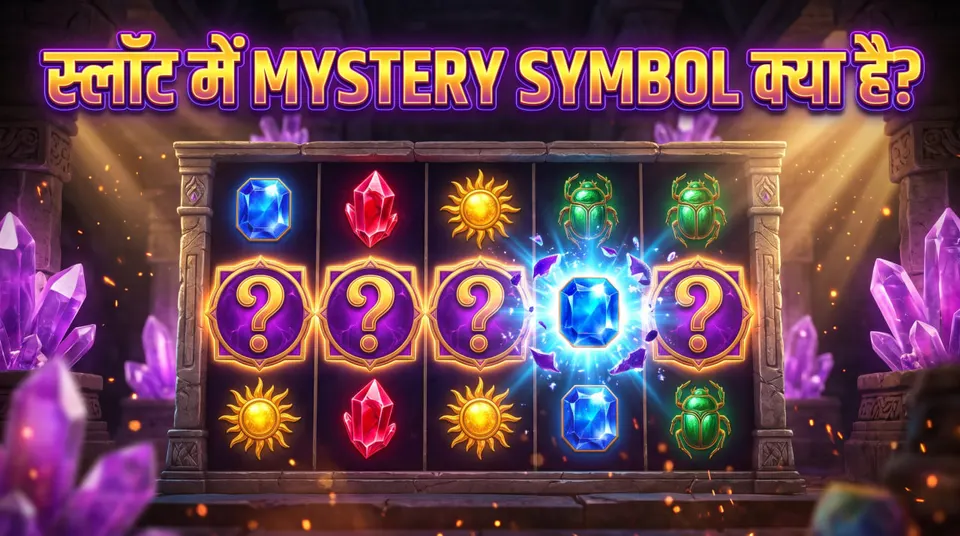
A game might use a separate key symbol, collection symbol, mystery symbol, or feature emblem.
Those are design choices rather than universal definitions.
The most reliable reference is always the particular game's rules.
Why Symbol Names Can Be Misleading
Two games might display nearly identical Wild icons but give them different functions.
Likewise, two Scatter symbols may look similar while using different thresholds or eligible positions.
It is easy to assume the same symbol name means the same behaviour everywhere.
That is often incorrect.
Consider how different games may use reels, paylines, ways-to-win systems, clusters, or symbol collections.
A Wild designed for a traditional payline game might behave differently from a Wild designed for a cluster-matching system.
A Scatter on a five-reel grid may also follow different counting rules from a Scatter on a larger grid.
These differences are reasons to check the game's information panel, not reasons to assume that one particular symbol is more advantageous.
Common Mistakes When Reading Wild and Scatter Symbols
Mistake 1: Assuming Wild means an automatic prize.
A Wild usually needs to form a qualifying combination.
Mistake 2: Assuming Scatters must appear on a payline.
Some formats allow them to count anywhere, while others have restrictions.
Mistake 3: Assuming Wild can always replace Scatter.
Many games exclude special symbols from Wild substitution.
Mistake 4: Assuming every Scatter activates a feature.
A game may require a minimum number or specific positions.
Mistake 5: Confusing a multiplier with a symbol substitute.
A multiplier and a Wild are different mechanics, although a game may combine them.
Mistake 6: Assuming Sticky Wilds last indefinitely.
Their duration depends on the feature rules.
Mistake 7: Treating different games' paytables as interchangeable.
Similar visuals do not guarantee matching rules.
How to Understand a Slot Symbol Paytable
A paytable or information panel can explain the role of each symbol and how combinations are evaluated.
When examining one, focus on five questions.
First, what qualifies as a paying combination?
Second, which regular symbols can a Wild replace?
Third, how many Scatters are required for each possible effect?
Fourth, do special symbols have restrictions involving reel positions, feature modes, or multipliers?
Fifth, does the game use paylines, ways-to-win, clusters, or a different evaluation method?
These questions help interpret the interface without assuming that a visually impressive animation changes the game rules.
Frequently Asked Questions About Wild and Scatter Symbols
What is the difference between Wild and Scatter?
A Wild commonly substitutes for regular symbols, while a Scatter often follows separately defined rules for awards or features.
Can a Wild replace any symbol?
Not always. Many games restrict Wild substitutions, especially for Scatters and other dedicated feature symbols.
Does a Scatter have to land on a payline?
Not necessarily. Some Scatters count anywhere on the grid, while others have reel or position requirements.
Can a Scatter pay without a bonus feature?
Yes, some games award prizes for specified Scatter counts without requiring a separate feature activation.
Can Wild and Scatter appear together?
Yes. A game can display different types of special symbols in the same result.
What is an Expanding Wild?
It is a Wild that changes its coverage, such as expanding across a reel, when a defined feature condition occurs.
What is a Sticky Wild?
It is a Wild that remains in place for a defined period or number of feature events.
Can Scatters appear during a cascade?
They can in some games. Whether they count toward a feature depends on the game's rules.
Is a Scatter the same as a Bonus symbol?
Not necessarily. Scatter is a particular type of mechanic, while Bonus symbol is a broader term.
Do Wilds guarantee more frequent prizes?
No general guarantee follows from the presence of Wild symbols. Their effect depends on the game's complete design.
Final Thoughts
Wild and Scatter symbols are easy to recognise but easy to misunderstand.
The Wild commonly helps complete ordinary symbol combinations through substitution.
The Scatter often follows a different evaluation rule involving counts, positions, feature activation, or separately defined awards.
Modern slot formats can add expanding Wilds, sticky Wilds, special substitutions, multipliers, and cascading interactions.
That makes one principle especially useful: understand what a symbol does within a particular game, not just what its name suggests.
A clear understanding of these mechanics makes slot interfaces and paytables easier to read without confusing visual effects with universal rules.
Related Wikipura Articles
Editorial note: All symbol arrangements and feature rules used as examples are fictional illustrations, not descriptions of a particular commercial slot game.