Jalwa Colour Trading Game: Rules & Results Explained
Understand the Jalwa Colour Trading Game in 2026, including Red, Green and Violet, number results, countdown rounds, common mistakes, and India's online gaming rules.
In this article
- What Is the Jalwa Colour Trading Game?
- How Does a Jalwa Colour Prediction Round Work?
- Red, Green and Violet: What Do the Colours Mean?
- What Do Big and Small Mean?
- How to Read the Period Number and Results History
- Can You Predict the Next Jalwa Colour from Past Results?
- Seven Things Beginners Should Understand
- 1. Colour prediction is not financial trading
- 2. Learn what each number label means
- 3. Check which rules apply to the version you are viewing
- 4. Treat countdowns as display information
- 5. Keep results and predictions separate
- 6. Watch for fake apps and misleading links
- 7. Understand the law before any money is involved
- Is Jalwa Colour Trading Legal in India in 2026?
- How to Check Whether a Jalwa-Related Website Is Trustworthy
- Common Misunderstandings About Jalwa Colour Trading
- Frequently Asked Questions
- What is the Jalwa Colour Trading Game?
- Which colours are commonly used?
- What is a period number?
- What do Big and Small mean?
- Do previous results predict the next colour?
- Is Jalwa a stock trading simulator?
- Can a prediction bot guarantee a result?
- Is Jalwa Colour Trading legal in India?
- Is every Jalwa website the same?
- Final Thoughts
The Jalwa Colour Trading Game is commonly described as a colour-and-number prediction game, not a stock market simulator.
In a typical version, each round ends with a number or colour result, and players can view completed rounds in a results history. This beginner guide explains the basic terms, how the screens work, and why previous outcomes are not reliable predictions of future results.
What Is the Jalwa Colour Trading Game?
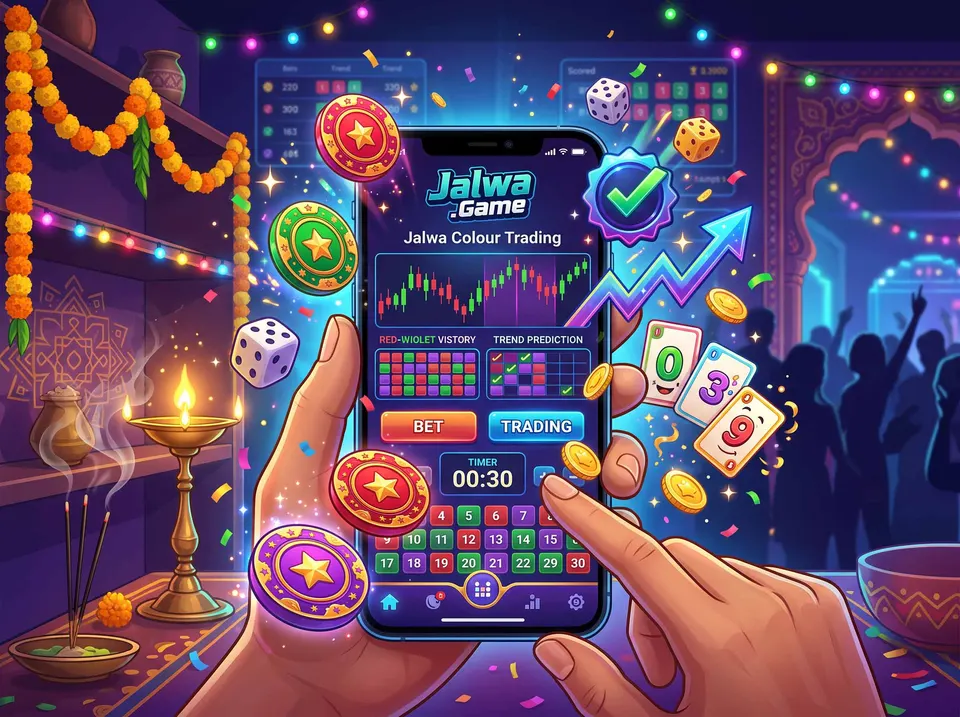
The name “colour trading” can be confusing. It sounds similar to buying and selling financial assets, but Jalwa-style colour prediction is a different activity. Users are generally shown colour options, a countdown timer, and a result after the round ends. Some versions also display numbers from 0 to 9 and labels such as Big or Small.
There is no stock exchange, portfolio of coloured commodities, or financial chart of prices to buy low and sell high in this basic format. The word “trading” is promotional terminology, not evidence that the game teaches genuine investing skills.
Different websites may use the Jalwa name or offer different game modes. Screens, labels, time limits, and rules can vary. Treat this article as a guide to a commonly described format rather than a verified manual for every website using that name.
How Does a Jalwa Colour Prediction Round Work?
A typical colour prediction screen presents a short repeating round. The user sees a period or round identifier, a countdown, available colour or number options, and a results area. After the countdown closes, the system displays a result and moves to the next period.
The basic sequence is:
- A new period begins and a countdown appears.
- The screen displays the choices associated with that period.
- The countdown reaches its closing point.
- The platform displays the resulting number or colour.
- The completed period is added to the results history.
This is a description of the interface, not a recommendation to wager money. The actual method used to generate a result and any settlement rules must be checked in the specific platform's published documentation.
Red, Green and Violet: What Do the Colours Mean?
Many WinGo-style colour prediction interfaces use three labels: Red, Green, and Violet. They are result categories associated with displayed numbers, not signs of market gains or losses.
A commonly shown reference is:
- Green: 1, 3, 7 and 9.
- Red: 2, 4, 6 and 8.
- Violet: 0 and 5.
In some versions, 0 is displayed as Red plus Violet and 5 as Green plus Violet. This explains why a single result may show two colour labels rather than one. Other interfaces may present these special results differently, so the platform's own colour legend takes priority.
For example, if the result number is 7, the chart usually labels it Green. If the result is 8, the chart usually labels it Red. A result of 0 or 5 may show Violet alongside another colour.
These labels help someone interpret a completed round. They do not establish what the next round will show.
What Do Big and Small Mean?
Some Jalwa-style interfaces also classify the number result by size. In the common 0–9 format, Small means 0 through 4 and Big means 5 through 9.
Small numbers:
- 0, 1, 2, 3, 4.
Big numbers:
- 5, 6, 7, 8, 9.
A result can therefore have several descriptions at once. Number 3, for example, is generally Green and Small. Number 8 is generally Red and Big. Number 5 is Big and may be displayed as Green and Violet.
Big and Small are labels within the game, not measures of risk, prize size, or how likely a future result is to occur. Do not confuse these terms with large and small investments in financial trading.
How to Read the Period Number and Results History
A results page may show a period ID, an outcome number, a colour indicator, and a Big or Small label. These fields help connect each result to the correct completed round.
To read a history entry, look at the period identifier first. Then find the number drawn for that period, check the colour mapping, and note its size category where shown.
For example, a history entry could display:
- Period: an identifying number assigned by the website.
- Result: 4.
- Colour: Red.
- Size: Small.
That entry describes what happened in one completed period. It does not reveal any hidden rule for the next period. If the displayed labels and numbers disagree with the platform's published rules, save the period ID and contact that platform's support rather than assuming the result is correct.
Can You Predict the Next Jalwa Colour from Past Results?
There is no reliable reason to assume that a sequence of past colours predicts the next result. In a genuinely random, independently generated system, previous draws do not make the next colour “due.”
Suppose the last four visible results are Green. It may feel as though Red must come next, but a streak on its own does not prove that. The reverse is also true: a run of Red results is not evidence that another Red result is guaranteed.
Some websites and social media accounts promote colour prediction formulas, sure-shot signals, VIP groups, or bots. A history chart can be useful for reviewing previous results, but it is not proof that someone can forecast future outcomes. Claims of guaranteed winnings or fixed daily income deserve particular caution.
The fairness and technical reliability of any specific platform also cannot be established just from a colourful interface. Look for independently verifiable information rather than trusting unsubstantiated claims about algorithms or audits.
Seven Things Beginners Should Understand
1. Colour prediction is not financial trading
The interface may use words such as trading, profit, or strategy, but selecting a colour is not the same as buying a share, owning an asset, or learning how markets operate.
2. Learn what each number label means
Understand Red, Green, Violet, Big, and Small as descriptions of the result. This prevents basic mistakes when reading past rounds.
3. Check which rules apply to the version you are viewing
Do not assume every website with the Jalwa name has the same timer, colour mapping, number display, or other rules. A screenshot from another site may be irrelevant.
4. Treat countdowns as display information
The timer shows where a round is in its cycle. It does not indicate that a particular outcome is more likely at a certain second.
5. Keep results and predictions separate
A completed result is a record. A guess about the future is a prediction. Mixing the two can make random streaks look meaningful when they are not.
6. Watch for fake apps and misleading links
Look closely at domain names, avoid unfamiliar download files, and do not share passwords, OTPs, banking PINs, or identity documents with unverified contacts. A logo or HTTPS padlock alone does not prove that a service is legitimate.
7. Understand the law before any money is involved
India's rules for online money gaming are materially different from rules for ordinary social games. A game appearing in search results does not mean that offering or participating in a money-based version is lawful.
Is Jalwa Colour Trading Legal in India in 2026?
India's Promotion and Regulation of Online Gaming Act, 2025, and the related 2026 rules introduced a nationwide framework that prohibits online money games as defined by the law. The rules took effect on 1 May 2026. The prohibition covers money games based on chance, skill, or a combination of both; the legal framework also restricts their promotion and associated payment services.
That does not mean every free-to-play colour-themed game is automatically illegal. The important distinction is the actual game model, especially whether money or other stakes are involved with an expectation of monetary winnings. A specific service's legal status cannot be verified from its marketing name alone.
For official details, read the Ministry of Electronics and Information Technology's information on the Promotion and Regulation of Online Gaming Rules, 2026: https://www.pib.gov.in/PressReleaseIframePage.aspx?PRID=2254606&lang=2®=48
This article is for informational purposes and does not recommend or facilitate participation in prohibited money gaming.
How to Check Whether a Jalwa-Related Website Is Trustworthy
Because websites and apps can use similar names, it is worth checking their identity before entering personal information.
- Confirm who operates the website and whether contact information is verifiable.
- Compare the domain with the address given in reliable, independent sources.
- Read its privacy policy and account-security information.
- Be skeptical of guaranteed profit, instant withdrawal, or fixed-result claims.
- Do not install an APK sent by an unknown contact simply because it carries a familiar logo.
- Do not provide an OTP or password to someone claiming they can fix or upgrade an account.
If a site asks for money or sensitive documents before clearly identifying the operator and the applicable rules, that is a reason to stop and investigate further.
Common Misunderstandings About Jalwa Colour Trading
One misunderstanding is that colours rise and fall in value like stock prices. That description belongs to financial markets, not the basic colour prediction format.
Another is that several consecutive results reveal a dependable pattern. Streaks can appear in random data without offering a useful forecast.
A third is that Red, Green, and Violet always have identical meanings on every platform. The common number mapping is a helpful reference, but individual rules must be checked.
A fourth is that an app available online is necessarily approved or legal in India. Availability alone is not evidence of authorisation.
Finally, some people assume that the longer they participate, the more likely they are to earn money. Repetition does not transform an uncertain result into a reliable source of income.
Frequently Asked Questions
What is the Jalwa Colour Trading Game?
It is a name commonly used for a colour-and-number prediction format with timed rounds and result histories. Despite the word “trading,” the basic format is not stock or commodity trading.
Which colours are commonly used?
Red, Green, and Violet are common labels. In one widespread 0–9 format, Green is associated with 1, 3, 7, 9; Red with 2, 4, 6, 8; and Violet with 0 and 5. Always check the version's legend.
What is a period number?
A period number is an identifier for a particular round. It helps users match a displayed outcome with the correct record in the results history.
What do Big and Small mean?
In a common 0–9 format, Small refers to 0–4 and Big refers to 5–9. These are number categories, not financial recommendations.
Do previous results predict the next colour?
No reliable prediction follows from past results alone. If rounds are random and independent, an earlier streak does not alter the next result's underlying chances.
Is Jalwa a stock trading simulator?
The colour prediction format discussed here is not a stock market simulator. Descriptions of buying and selling coloured shares or commodities are misleading in this context.
Can a prediction bot guarantee a result?
No credible guarantee can be established from the result history alone. Be cautious of bots, paid signals, and claims of certain winnings.
Is Jalwa Colour Trading legal in India?
Legality depends on the actual activity, not its name. India's nationwide framework prohibits online money games as defined in the 2025 Act and 2026 rules. A free online social game may be treated differently, depending on its features and legal classification.
Is every Jalwa website the same?
No. Similar brand names or layouts do not prove that websites share an operator, use the same rules, or provide the same protections.
Final Thoughts
Understanding Jalwa colour trading starts with recognising what it is: a colour-and-number results format, not a lesson in buying and selling investments. Learning the labels, period numbers, and result history makes the interface easier to understand, but none of those features provides a guaranteed prediction. For readers in India, checking the current legal framework and protecting personal information are more important than any supposed winning trick.