Wingo Big Small Explained: 0–4, 5–9 and Results Guide
Learn Wingo Big Small rules for numbers 0–9, why 0–4 are Small and 5–9 are Big, how to read completed results, and why past rounds cannot predict future outcomes.
In this article
- What Does Wingo Big Small Mean?
- Wingo Big Small Numbers from 0 to 9
- How Is a Wingo Big Small Result Decided?
- What Are Period Numbers and Countdown Timers?
- How Is Big Small Different from Red, Green, and Violet?
- Does Big Have a Higher Chance Than Small?
- Can Previous Big Small Results Predict the Next Round?
- How to Read Wingo Big Small History Correctly
- Seven Common Wingo Big Small Mistakes
- Is Wingo Big Small the Same as Bingo or Tambola?
- What Should Readers in India Know in 2026?
- Wingo Big Small: Key Takeaways
- Frequently Asked Questions About Wingo Big Small
- What is Wingo Big Small?
- Is 0 Big or Small in Wingo?
- Is 5 Big or Small in Wingo?
- Which Wingo numbers are Small?
- Which Wingo numbers are Big?
- Is Big more likely to appear than Small?
- Can Wingo Big Small history predict the next result?
- What is the difference between a period number and a result number?
- Does Big mean a bigger payment?
- Are online money games legal in India in 2026?
Wingo Big Small is a number label used in many WinGo-style games: results from 0 to 4 are called Small, while results from 5 to 9 are called Big. This beginner-friendly guide explains how the labels work, how to read a completed round, and why previous Big or Small results cannot reliably predict the next one.
What Does Wingo Big Small Mean?
Wingo Big Small describes the size category assigned to the result number of a round. It does not refer to the size of the screen, the duration of the round, or the amount of money involved.
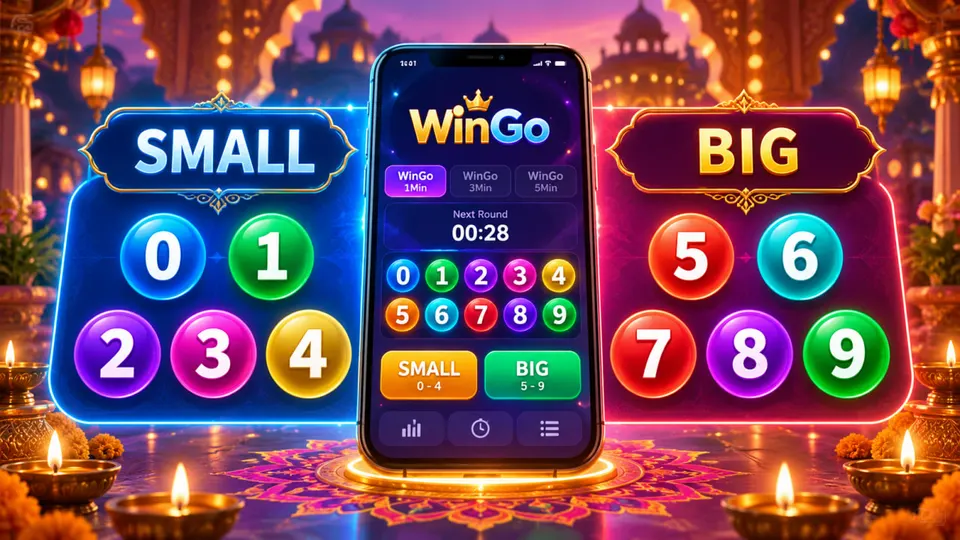
In a commonly used WinGo format, each completed round produces a number from 0 to 9. The number is then placed in one of two groups:
- Small: 0, 1, 2, 3, and 4.
- Big: 5, 6, 7, 8, and 9.
That is the basic rule. If the result number is 2, its size label is Small. If the result number is 7, its size label is Big.
WinGo-style platforms can differ, so the specific game's published rules should always take priority over a general guide.
Wingo Big Small Numbers from 0 to 9
A quick way to remember the Wingo Big Small number ranges is to divide the ten possible digits into two groups of five.
Small number group
- 0 — Small
- 1 — Small
- 2 — Small
- 3 — Small
- 4 — Small
Big number group
- 5 — Big
- 6 — Big
- 7 — Big
- 8 — Big
- 9 — Big
Two numbers deserve extra attention. Zero belongs to Small, even though some beginners think zero should be excluded. Five belongs to Big, even though it sits near the middle of the number range.
There is no separate Middle category in this common 0–9 arrangement. The dividing line is between 4 and 5.
How Is a Wingo Big Small Result Decided?
A Big or Small label is determined by the result number shown for a completed period. You only need the final number to understand the classification.
Imagine a results screen showing these three completed rounds:
- Round A ends with 3. Its size is Small.
- Round B ends with 8. Its size is Big.
- Round C ends with 5. Its size is Big.
These are fictional examples for learning the labels, not live results or predictions.
The number comes first; Big or Small is the category attached to it. For this reason, the size result and the number result should not be treated as two separate draws.
A useful habit when reading a screen is to locate the final number before interpreting any coloured badge or size icon. Labels and layouts can change across websites, but the displayed result number makes the grouping easier to check.
What Are Period Numbers and Countdown Timers?
Some WinGo-style interfaces show a countdown timer and a period ID beside the number choices or past results. These elements serve different purposes from the Big/Small labels.
Period ID
A period ID identifies a specific round. It may be a long sequence of digits. Its purpose is to help distinguish one round from another, not to define whether the final result is Big or Small.
Countdown timer
A countdown indicates the time remaining in a current period. The available durations, exact display, and when a result becomes final depend on the platform.
Result history
The history section may list a completed period, its result number, and the Big/Small label. It is useful for checking what was displayed in past rounds, but not for establishing what must happen in the future.
Do not mistake a number inside a long period ID for the one-digit final result. A period ID ending in 8 does not automatically mean the outcome is Big.
How Is Big Small Different from Red, Green, and Violet?
Big/Small and colour are two ways of describing a result, but they answer different questions.
- Big or Small tells you whether the final digit falls in 0–4 or 5–9.
- Red, Green, or Violet refers to a colour label associated with the digit under the relevant platform's chart.
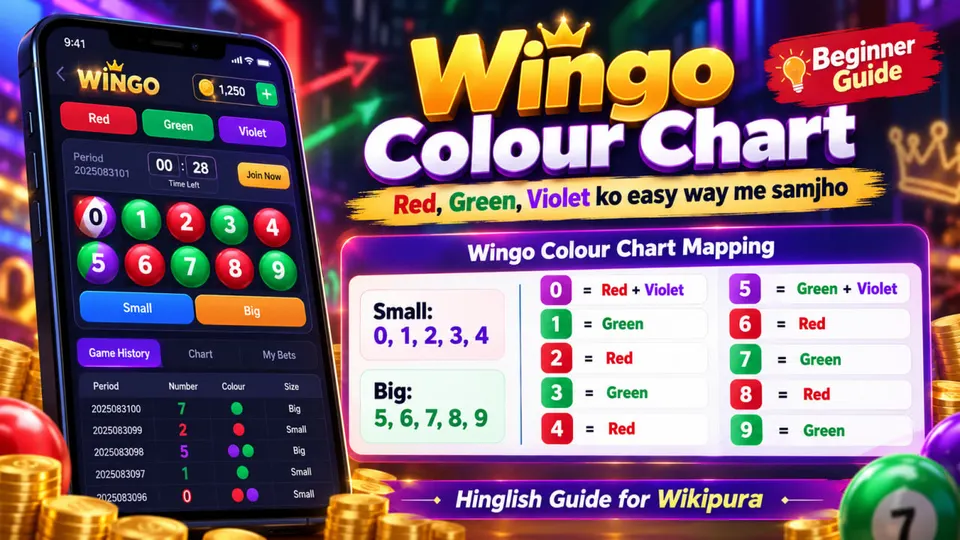
For example, in a commonly used WinGo number-to-colour chart, the number 8 is Big and Red, while the number 1 is Small and Green. The number 0 may be Small and labelled Red plus Violet; 5 may be Big and labelled Green plus Violet.
Neither colour nor size is a promise of a future outcome. If you need the full colour mapping, see Wikipura's Wingo Colour and Number Chart Guide.
This article focuses on the Big/Small grouping, rather than repeating every colour rule.
Does Big Have a Higher Chance Than Small?
Not simply because its name is Big. In the basic 0–9 system, both groups contain five numbers.
If — and only if — a game independently generates each digit from 0 to 9 with equal probability, the mathematical chance of either category on one round is:
- Small: five digits out of ten, or 50%.
- Big: five digits out of ten, or 50%.
This is a conditional mathematical example. It is not proof that a particular app uses a fair, independent, or uniformly random result generator. Without verified technical documentation or an independent audit, the true selection process of a platform cannot be assumed from its interface.
A label such as Big also does not mean a bigger reward, a safer outcome, or an advantage over Small. Those would be separate claims requiring specific evidence.
Can Previous Big Small Results Predict the Next Round?
A history of Big and Small results shows past outcomes. It does not establish a dependable prediction method.
Suppose five completed rounds all display Small. It might feel as though Big must appear next, but that feeling is not a rule. Under independent, equally likely outcomes, the next round would still have the same category probabilities as before.
This mistaken belief is often called the gambler's fallacy: assuming a random outcome becomes due because it has not appeared recently.
The opposite claim is also unreliable. A run of Big results does not prove that another Big is about to follow. Sequences may look meaningful after they happen, even when they provide no useful information about the next result.
Avoid treating chart screenshots, prediction bots, streak counters, or claimed secret formulas as evidence of guaranteed accuracy.
How to Read Wingo Big Small History Correctly
A clear results history helps readers understand what happened in completed rounds. Here's a fictional example:
- Result 9 — Big
- Result 4 — Small
- Result 0 — Small
- Result 6 — Big
- Result 5 — Big
First, check that each row belongs to a different completed period. Then identify the single-digit result and confirm its correct label. Finally, separate what the history actually records from any speculation about a later round.
In the example, the history contains three Big results and two Small results. This describes only those five rounds. It does not establish an advantage, a reliable trend, or the next outcome.
If a screen's size badge disagrees with the number mapping in this article, consult that platform's rules before concluding that the result is wrong.
Seven Common Wingo Big Small Mistakes
Beginners often misunderstand Big/Small because of the names, the screen design, or claims circulating online.
1. Calling 5 a Small number. In the common 0–9 format, 5 begins the Big group.
2. Treating 0 as neither category. Zero is included in Small.
3. Reading the period ID as the result. A period identifier is different from the one-digit outcome.
4. Thinking Big means a larger reward. Big refers to the numerical range, not a guaranteed amount of money.
5. Confusing colour with size. One digit can have both a size label and a colour label.
6. Believing the next result is due. An earlier streak does not guarantee a reversal or continuation.
7. Assuming every website has identical rules. Interfaces and settlement terms can vary; check the specific platform's published information.
Understanding these differences makes the screen easier to interpret without relying on misleading claims.
Is Wingo Big Small the Same as Bingo or Tambola?
No. The 0–9 Big/Small system described here is different from traditional Bingo or Tambola, where participants may use numbered tickets or cards and complete patterns as numbers are called.
A WinGo-style Big/Small result is usually a single digit assigned to a size category. You do not need to complete a ticket row or a full house to understand the label.
This distinction matters because many online articles accidentally combine the instructions for unrelated games. For general terminology, read Wikipura's What Is Wingo Game? overview, then return to this page for the Big/Small grouping.
What Should Readers in India Know in 2026?
This guide explains game terminology for educational purposes. It does not recommend joining a real-money game, making a deposit, or following an unverified gambling website.
India's Promotion and Regulation of Online Gaming Act, 2025, together with the Online Gaming Rules, 2026 that came into force on 1 May 2026, establishes national restrictions on online money games as legally defined, including games based on chance or skill. The framework also restricts related advertising and financial facilitation.
The legal classification of any particular product depends on its actual operation. A website's availability, an attractive interface, or a claim to be a skill game does not establish that its real-money features are lawful.
For the official policy explanation, see the Government of India's Press Information Bureau update on the Online Gaming Rules, 2026.
Wingo Big Small: Key Takeaways
Wingo Big Small is easy to understand once the number range is clear: 0–4 means Small, and 5–9 means Big in the common format. The important boundary is between 4 and 5.
The result number identifies the category. A countdown, a period ID, or a history chart provides context about rounds, but it does not turn past results into reliable future predictions. Use the chart to read labels accurately, check platform-specific rules, and be cautious about unsupported claims.
Frequently Asked Questions About Wingo Big Small
What is Wingo Big Small?
Wingo Big Small is a classification used in many WinGo-style games. A result digit from 0 to 4 is labelled Small, and a digit from 5 to 9 is labelled Big.
Is 0 Big or Small in Wingo?
Zero is Small in the commonly used 0–9 number grouping.
Is 5 Big or Small in Wingo?
Five is Big. It is the first number in the Big group.
Which Wingo numbers are Small?
The Small numbers are 0, 1, 2, 3, and 4.
Which Wingo numbers are Big?
The Big numbers are 5, 6, 7, 8, and 9.
Is Big more likely to appear than Small?
Not in an idealised system where each of the ten digits is equally likely: both groups would have five outcomes and a 50% probability. That does not verify the fairness of any particular platform.
Can Wingo Big Small history predict the next result?
No reliable prediction follows from history alone. Past results can describe earlier rounds but cannot guarantee a future Big or Small result.
What is the difference between a period number and a result number?
A period number identifies the round. A result number is the digit that appears when the round is complete and determines whether its label is Big or Small.
Does Big mean a bigger payment?
No. Big describes a result number from 5 to 9. It is not a general statement about prizes or payments.
Are online money games legal in India in 2026?
India's 2025 online gaming law and 2026 rules prohibit online money games within the legal definition. The details of a particular platform must be assessed against the law; this article is not legal advice.